

How Systems, Templates, and Processes Eliminate Silos
What Is SEO Workflow Management?
SEO workflow management is the process of creating repeatable systems that move SEO work efficiently through an organization.
While many marketers think SEO workflow management is simply assigning tasks in a project management platform, the reality is much broader.
An effective SEO workflow is tied to the SEO process and connects strategy, deliverables, resource planning, execution, reporting, and accountability into a unified system. It ensures that SEO initiatives move consistently through content, development, PR, analytics, brand, and leadership teams without becoming trapped in operational bottlenecks.
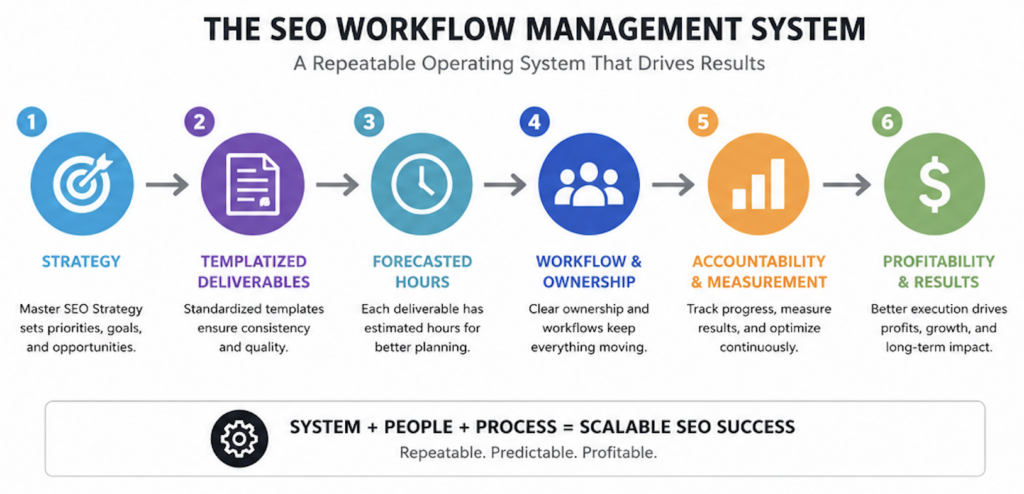 The most successful organizations don’t rely on memory, heroics, or individual expertise.
They rely on documented processes, standardized deliverables, clear ownership, and repeatable templates that make execution predictable and scalable.
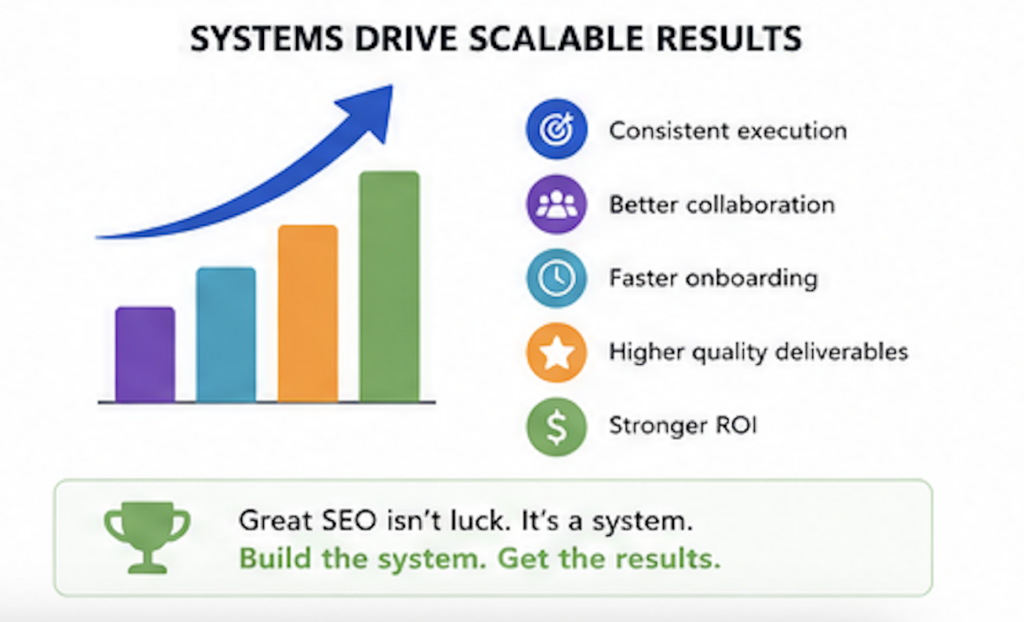
Without systems, SEO becomes reactive. With systems, SEO becomes sustainable.
Why Do Most SEO Strategies Fail After Planning?
Most SEO strategies do not fail because the keyword research was weak. They fail because organizations cannot execute consistently. Whether you’re in-house or in an Enterprise SEO agency, SEO operational leadership will make or break your SEO efforts.
- The strategy deck gets approved.
- The audit gets shared.
- The roadmap looks impressive in a meeting.
- Then execution disappears into operational fog.
- Content waits for approvals.
- Developers prioritize other tickets.
- PR publishes without search alignment.
- Brand teams rewrite optimized copy.
- Social campaigns launch disconnected from search demand.
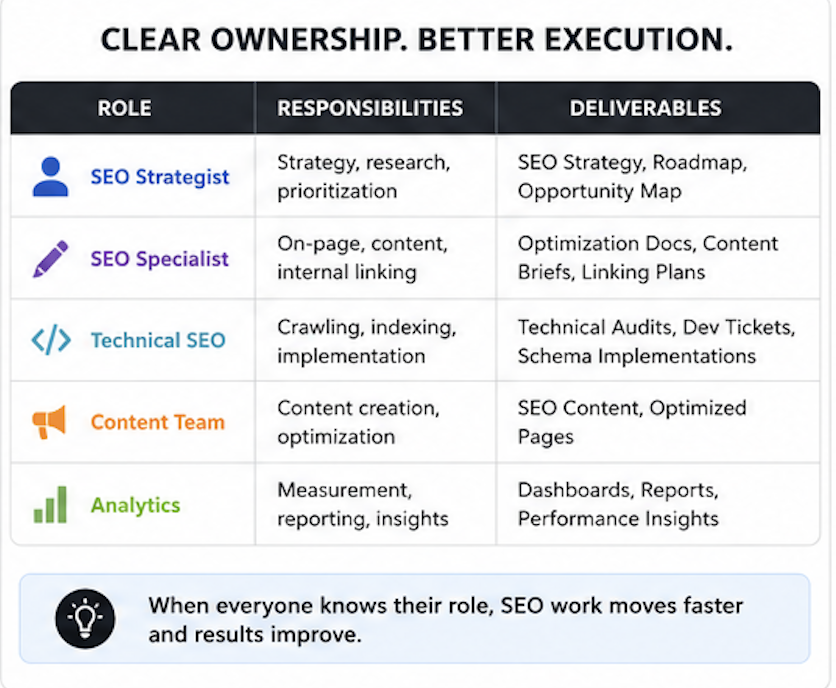
Nobody owns the process from start to finish.
This is where most SEO programs quietly stall.
Not because teams lack expertise.
Because they lack systems.
Many organizations create great strategies but fail to build the operational framework required to support execution.
The result is confusion, delays, duplicated work, missed opportunities, and inconsistent results.
What Causes SEO Execution Problems Inside Organizations?
 The biggest issue is rarely the SEO strategy itself.
It’s workflow fragmentation and no defined process for SEO operations.
SEO impacts nearly every department, including:
- Content
- Development
- UX
- Analytics
- Brand
- PR
- Social media
- Leadership
Yet most organizations still operate in silos.
Each department follows different processes, different priorities, and different timelines.
This creates friction everywhere.
SEO recommendations get delayed.
Content gets published without search alignment.
Technical improvements lose priority.
Reporting becomes disconnected from execution.
The solution is not more meetings.
The solution is creating systems that establish consistent expectations for everyone involved.
What Does a Mature SEO Workflow Management System Look Like?
Most organizations think SEO workflow management begins when work is assigned. This SEO project management can be documented in a simple Google Sheet or in a task management tool like Asana.
In reality, effective SEO workflow management begins long before execution starts.
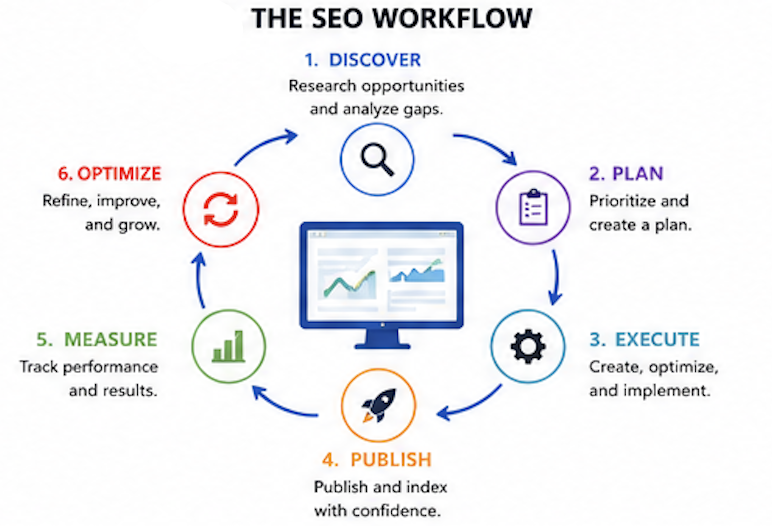 The highest-performing SEO teams create standardized systems for every major initiative, from technical SEO and content strategy to on-page optimization and authority building.
Each deliverable follows a workflow stage with a documented process, a predefined template, an estimated level of effort, and a measurable business outcome.
This creates consistency across teams while making execution easier to forecast, manage, and scale.
Instead of asking:
- How should we perform this task?
- How long will this take?
- Who owns this deliverable?
- What should the final output look like?
The answers already exist inside the system. Each task is assigned by an SEO manager, where those tasks live inside of the SEO project management workflow. This is the key to success for internal teams, SEO performance, and client satisfaction.
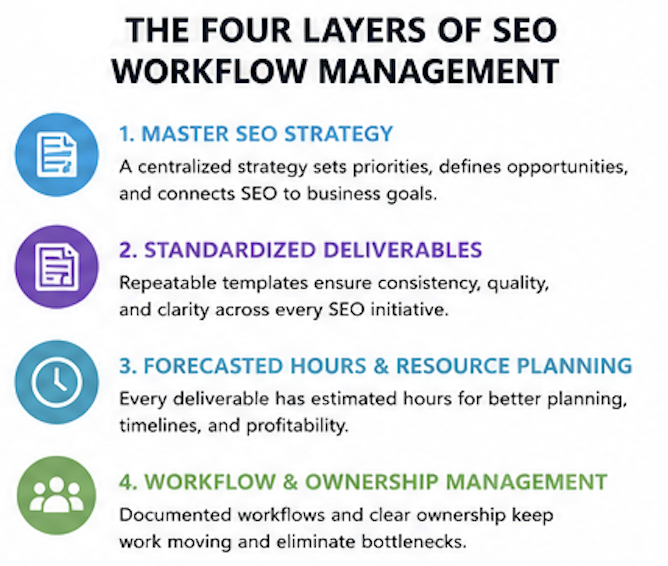
The Four Layers of Effective SEO Workflow Management
1. A Master SEO Strategy
Every initiative should connect back to a centralized strategy.
The strategy becomes the source of truth for the entire SEO campaign.
It establishes:
- Business objectives
- Keyword opportunities
- Content priorities
- Technical priorities
- Competitive positioning
- SEO KPI Success metrics
Without a centralized SEO strategy, teams often optimize individual tasks without understanding how they contribute to larger business goals.
2. Standardized SEO Deliverables
One of the most overlooked components of SEO workflow management is deliverable standardization.
Every major SEO initiative should have a repeatable framework.
Examples include:
- Technical SEO audits
- Keyword mapping
- Competitor ranking analyses
- Content briefs
- On-page optimization recommendations
- Internal linking strategies
- Client SEO dashboards for reporting
- SEO roadmaps
When every deliverable follows the same structure, quality remains consistent regardless of who creates it.
Clients know what to expect.
Stakeholders know how to interpret recommendations.
Teams spend less time reinventing the wheel.
3. Forecasted Hours and Resource Planning
Many SEO teams struggle because they don’t connect execution to resource planning.
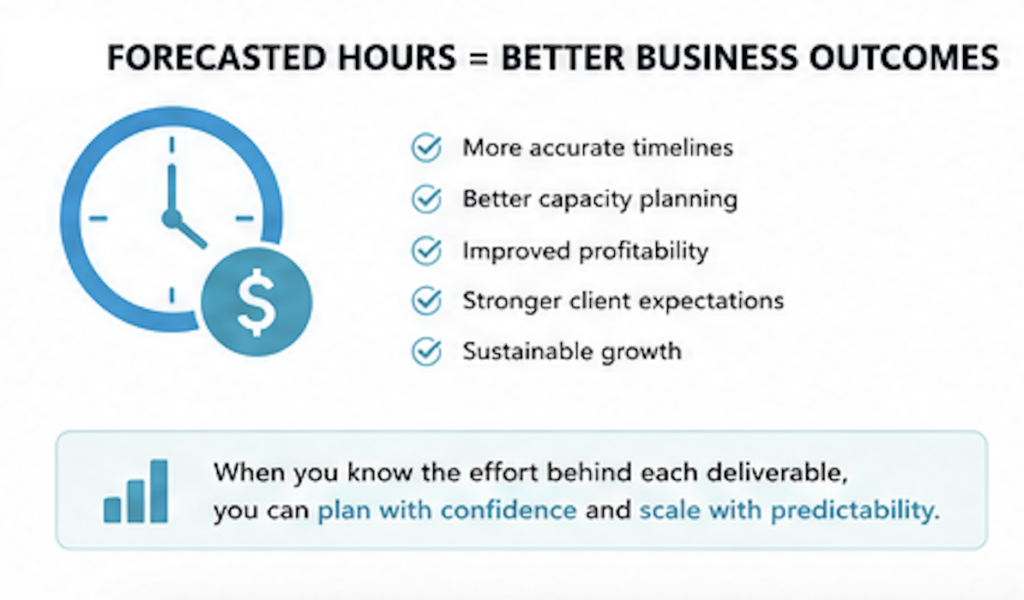
Every deliverable should have forecasted hours attached to it.
 For example:
- Technical SEO audits
- Content optimizations
- Keyword mapping
- Content strategy
- Content briefs
- Content production
- Reporting
- Internal linking analysis
When effort is forecasted consistently, organizations gain:
- Better capacity planning
- More accurate timelines
- Improved profitability
- Better resource allocation
- Clearer stakeholder expectations
This creates a stronger operational foundation while helping leadership understand the true investment required to achieve results.
4. Workflow and Ownership Management
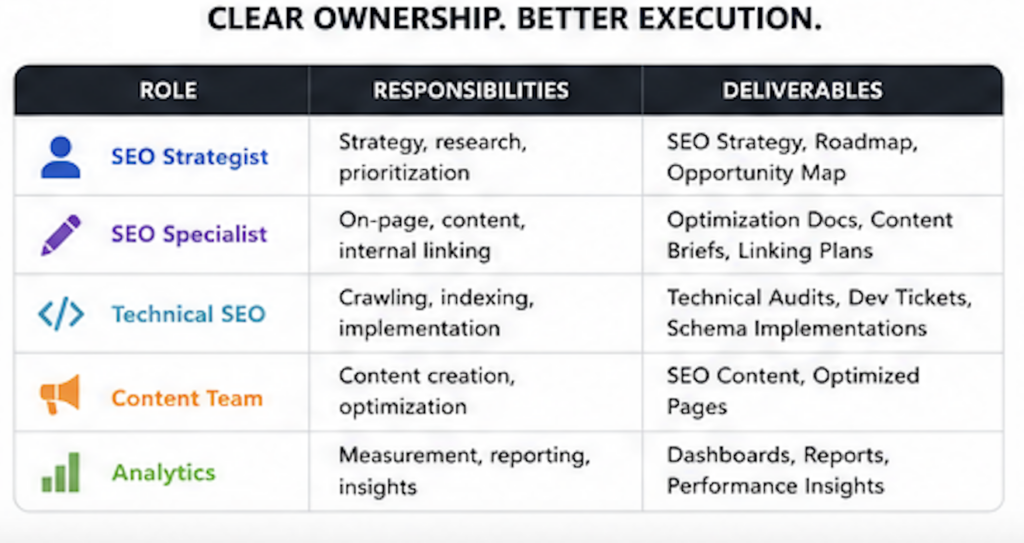 Once deliverables are defined and resourced, work moves through a documented workflow.
Every initiative should answer:
- What needs to happen?
- Who owns it?
- When is it due?
- What does success look like?
Clear ownership dramatically reduces bottlenecks and accountability issues.
When ownership is unclear, projects stall.
When ownership is defined, execution accelerates.
Why Are Templates Essential to SEO Workflow Management?
One of the fastest ways to improve SEO execution is through standardization.
Every time a team asks:
- What should this content brief include?
- What information does development need?
- How should recommendations be prioritized?
- What belongs in this report?
- How do we deliver this analysis?
They’re spending time solving a problem that should already have a documented answer.
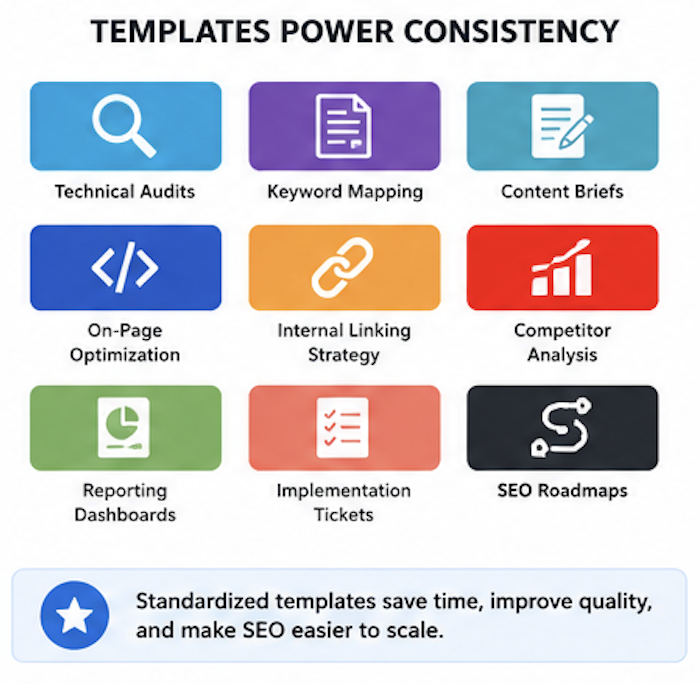
This is where templates become operational assets.
Templates create consistency across:
- Technical audits
- Keyword research
- Content briefs
- Content optimization
- Internal linking recommendations
- Reporting dashboards
- SEO roadmaps
- Implementation tickets
- Stakeholder communications
Instead of repeatedly deciding how work should be performed, teams can focus on execution.
How Do Templates Improve Training and Onboarding?
Many organizations accidentally build SEO programs around specific individuals.
The problem is that expertise does not scale.
Systems do.
When processes only exist inside someone’s head:
- Training takes longer.
- Knowledge gets lost.
- Deliverables become inconsistent.
- New employees struggle to ramp up.
- Clients receive different experiences.
Templates solve these challenges.
They create organizational memory.
They make it easier to train:
- New SEO team members
- Content teams
- Marketing managers
- Agency partners
- Internal stakeholders
When workflows are documented, onboarding becomes faster and quality remains consistent.
The system becomes bigger than any one individual.
How Does SEO Workflow Management Reduce Organizational Friction?
One of the most overlooked benefits of workflow management is stress reduction.
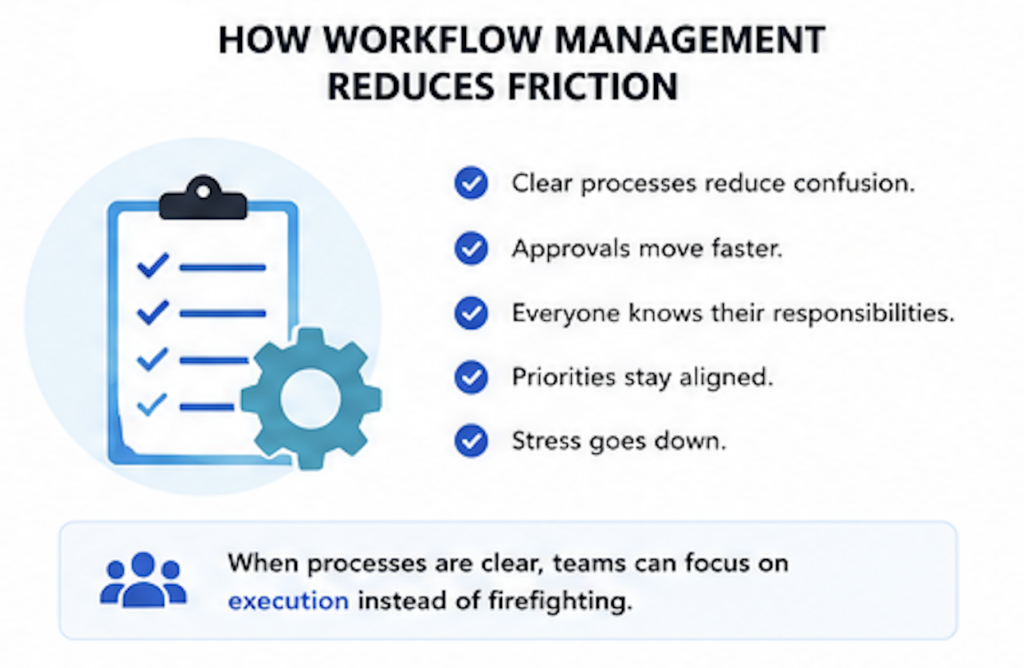
When processes are documented and expectations are clear:
- Teams spend less time seeking clarification.
- Stakeholders understand their responsibilities.
- Approvals move faster.
- Deliverables become more predictable.
- Communication improves.
- Priorities become easier to manage.
This creates alignment across teams.
Instead of SEO feeling like an interruption to existing workflows, it becomes part of how work naturally moves through the organization.
The result is operational harmony.
Everyone understands what needs to happen, who owns it, and how success is measured.
What Does Effective Cross-Functional SEO Look Like?
High-performing organizations build systems that support execution before work begins.
 Standardized Content Intake
Every content request follows the same framework.
Requests include:
- Search intent
- Target audience
- Keyword themes
- Business goals
- Internal linking opportunities
- Distribution plans
This creates consistency before content production starts.
Shared Workflow Visibility
SEO requirements live inside project management platforms, sprint boards, editorial calendars, and campaign planning tools.
SEO is not hidden inside separate documents.
It is embedded directly into existing workflows.
Defined Ownership
Every task has a designated owner.
This includes:
- Technical implementation
- Metadata updates
- Content optimization
- Schema deployment
- Reporting
- Link-building initiatives
Clear ownership eliminates confusion and reduces bottlenecks.
Repeatable Processes
The most mature SEO organizations rely on documented systems rather than individual memory.
This allows teams to scale execution while maintaining quality and accountability.
How Can Organizations Improve SEO Workflow Management?
Start by documenting your current process.
Identify:
- Bottlenecks
- Approval delays
- Ownership gaps
- Repetitive tasks
- Communication failures
- Workflow inefficiencies
Then create templates and processes that eliminate unnecessary decisions.
The goal is not to create more process.
The goal is to create better process.
Good workflow management removes friction.
It creates clarity.
It improves accountability.
And it allows SEO teams to spend less time managing work and more time driving results.
What Do High-Performing SEO Organizations Understand That Others Miss?
They understand that SEO execution is an organizational design problem.
Not just a marketing problem.
The organizations winning today are capable of:
- Publishing consistently
- Aligning messaging
- Coordinating teams
- Maintaining technical quality
- Scaling authority
- Forecasting resources
- Standardizing deliverables
- Reducing operational friction
They treat every SEO initiative as part of a larger operational framework.
The strongest organizations connect strategy, deliverables, forecasting, workflow management, and measurement into a repeatable system.
That system becomes a competitive advantage.
Final Thoughts
Most SEO challenges are not caused by algorithms.
They’re caused by operational complexity.
Organizations that succeed with SEO understand that execution is a systems problem.
They create documented processes.
They standardize deliverables.
They forecast resources.
They establish ownership.
They build templates that reduce ambiguity.
They make SEO easier to repeat, easier to scale, and easier to sustain.
At its core, SEO workflow management is not about managing tasks.
It’s about creating a repeatable operating system that aligns teams, reduces stress, improves profitability, and transforms strategy into consistent execution.
