A Practical Workflow for Teams, Agencies, and Account Managers
What is the SEO process?
The SEO process is a structured workflow that combines technical SEO, competitor research, AI visibility analysis, keyword mapping, content strategy, optimization, reporting, and ongoing performance improvements to improve organic visibility, strengthen search engine ranking, and drive long-term business growth.
Modern search engine optimization is no longer a collection of disconnected tasks. SEO is also an operational system where technical health, search intent, AI visibility, content planning, reporting, and user experience all work together to support sustainable growth across the search engine ecosystem.
The SEO Process
 The problem is that many SEO campaigns still operate in silos. Technical audits happen without content alignment. Reporting exists without a strategic context. Teams publish content without clear keyword mapping or internal linking strategies. Account managers are left translating fragmented updates into coherent narratives for clients and stakeholders.
The result is often:
- Unclear priorities
- Reactive execution
- Delayed implementation
- Frustrated teams
- Inconsistent reporting
- Campaigns that drift instead of scale
Whether you’re an SEO specialist, agency partner, account manager, or part of a digital marketing agency, understanding how the full SEO workflow fits together creates stronger campaigns, better communication, and more scalable systems.
Why Is SEO a Process Made Up of Specialized Workflows?
SEO campaigns are not driven by a single checklist. They’re built through a series of interconnected stages, each supported by its own workflows, deliverables, and optimization checklists.
A technical SEO checklist helps uncover crawl and indexing issues. A keyword mapping checklist organizes search intent into scalable content opportunities. A reporting checklist helps teams monitor visibility, performance trends, and next steps.
Each checklist plays an important role, but the real value comes from how those SEO workflows connect together across the larger campaign.
One of the biggest problems in modern SEO is that teams often treat audits, content creation, optimization, reporting, and strategy as isolated activities instead of coordinated parts of a unified process.
This creates:
- Disconnected priorities
- Siloed execution
- Inconsistent communication
- Delayed implementation
- Reactive decision-making
Modern SEO works best when every stage supports the next.
Technical audits inform competitor analysis. Competitor insights shape keyword mapping. Keyword mapping guides content planning. Reporting identifies optimization opportunities. Ongoing analysis improves campaign performance over time.
Instead of viewing SEO as a collection of disconnected tasks, successful organizations approach it as an operational framework supported by specialized workflows, collaborative systems, and continuous optimization.
What Happens During a Technical SEO Audit?
Every SEO campaign should begin with a technical crawl and audit.
Before building content strategies or targeting keywords, teams need to understand whether search engine crawlers can properly crawl, index, render, and interpret the website.
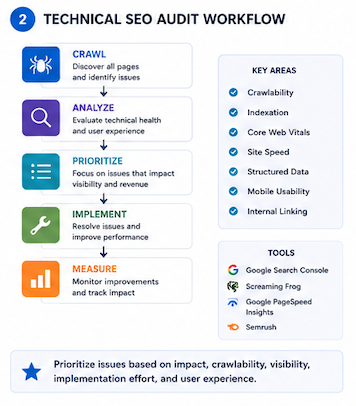
Technical SEO audits help uncover issues like:
- Crawl errors
- Broken internal links
- Duplicate content
- Indexing problems
- Redirect chains
- Core Web Vitals issues – Page Load Time issues
- Structured data errors
- Orphan pages
This phase creates the technical foundation for the rest of the campaign.
Common SEO Audit Tools
- Semrush
- Google Search Console
- Screaming Frog
- Google PageSpeed Insights
Key Deliverables
- Technical crawl report
- Issue prioritization
- Indexing analysis
- Technical roadmap
- Implementation recommendations
One of the biggest mistakes teams make is treating every issue with equal urgency. Strong SEO operations prioritize fixes based on business impact, crawlability, visibility, implementation effort, and overall user experience.
How Do You Perform an SEO Competitor Analysis?
Competitor analysis helps teams understand what is already performing within the search landscape.
But modern SEO competitor analysis goes beyond backlinks and rankings. It should also evaluate:
- Topical authority
- Content depth
- Search intent alignment
- SERP features
- Internal linking structures
- AI Overview visibility
- Thematic messaging
- Entity associations
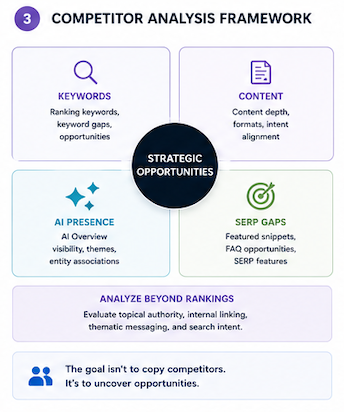 Your real search competitors are the websites consistently dominating the search engine results page for your target topics, even if they are not direct business competitors.
What Should Be Included in a Competitor Analysis?
- Ranking keywords
- Content gaps
- keyword gaps
- FAQ opportunities
- Content formats
- Internal linking strategies
- AI visibility themes
- Featured snippet opportunities
Common SEO Research Tools
- Semrush Organic Research
- Semrush Keyword Gap
- Google Search
- Google Keyword Planner
- AI search tools
Competitor analysis should help teams identify strategic opportunities, not simply imitate what competitors are doing.
What Is AI Visibility in SEO?
AI visibility measures how brands, topics, and content appear across AI-powered search experiences like AI Overviews, ChatGPT, Gemini, Perplexity, and other answer engines. It’s not just SEO these days; it’s a blend of SEO, AEO, and GEO.
This layer of SEO is becoming increasingly important because search behavior is shifting from traditional rankings toward synthesized answers and entity-driven discovery through AI search experiences.
AI visibility analysis helps organizations understand:
- How their brand is being interpreted
- What topics are associated with competitors
- Which themes dominate AI-generated answers
- Where messaging gaps exist
- Which questions repeatedly surface across search ecosystems
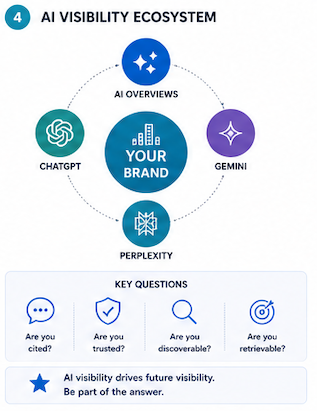
Why AI Visibility Matters
AI-powered search experiences often reward:
- topical authority
- semantic clarity
- structured information
- trustworthy citations
- entity relationships
- well-organized content ecosystems
This means modern SEO campaigns should optimize not just for rankings, but for retrievability, contextual relevance, and thematic authority.
How Does Keyword Mapping Support SEO Strategy?
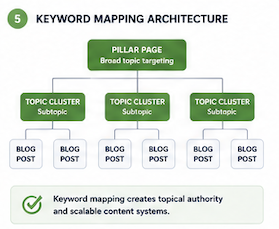 Keyword mapping organizes search intent into a scalable content architecture.
Instead of targeting random keywords independently, keyword mapping connects:
- Topics
- Search intent
- Target URLs
- User journeys
- Internal linking opportunities
- Content clusters
This process helps prevent:
- Keyword cannibalization
- Overlapping content
- Disconnected blog strategies
- Weak topical authority
What Should a Keyword Map Include?
- Primary keywords
- Secondary keywords
- Target URLs
- Content types
- Search intent
- Funnel stage
- Supporting internal links
Common Keyword Mapping Tools
- Semrush Keyword Strategy Builder
- Google Drive
- Google Sheets
- Microsoft Excel
Strong keyword research and mapping create the blueprint for topical authority and scalable content planning.
What Is Included in On-Page SEO Optimization?
On-page SEO optimization improves how search engines and users interpret individual pages.
This includes optimizing:
- Title tags
- Meta descriptions
- Heading structure
- Internal links
- Structured data
- Semantic relevance
- Readability
- FAQ content
- Image optimization
Modern on-page SEO should also support:
- AI readability
- Entity reinforcement
- Featured snippet optimization
- Answer engine optimization
- Semantic search relevance
The strongest pages are often the ones that clearly answer user questions while providing contextual depth and strategic internal linking.
Strong on-page optimization also helps improve visibility across both traditional search results and AI-generated answers.
Why Is Internal Linking Important for SEO?
Internal linking helps search engines understand relationships between pages, topics, and content clusters.
A strong internal linking strategy:
- Improves crawl depth
- Distributes authority
- Reinforces topical relationships
- Supports navigation
- Strengthens semantic context
Internal linking also helps connect supporting content back to pillar pages, creating stronger topical ecosystems over time.
For example:
- Keyword mapping articles can support content strategy pages
- AI visibility pages can support competitor analysis content
- Reporting pages can support campaign management workflows
Strong internal linking transforms individual articles into connected knowledge systems and can improve overall domain authority over time.
How Does Content Planning Support SEO Campaigns?
Content planning transforms SEO research into an organized editorial strategy.
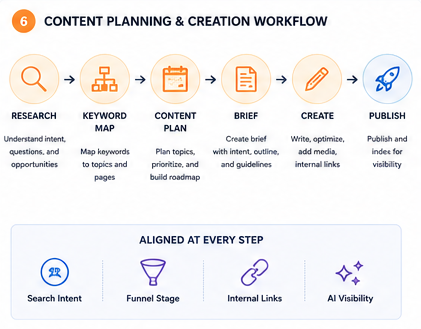 This stage determines:
- Which topics to prioritize
- What content to create
- How pages support business goals
- How content supports topical authority
- Where AI visibility opportunities exist
- How campaigns evolve over time
Strong content planning balances:
- Evergreen content
- Strategic commercial pages
- Informational search intent
- Content refresh opportunities
- AI visibility optimization
What Should an SEO Content Plan Include?
- Editorial calendars
- Keyword clusters
- Publishing workflows
- Ownership assignments
- Performance goals
- Optimization schedules
Without structured planning, content creation often becomes reactive instead of strategic.
Strong planning also helps align SEO with broader content marketing and search engine marketing initiatives.
What Makes SEO Content Creation Effective?
SEO content creation is no longer just about inserting keywords into articles.
Effective SEO content:
- Aligns with search intent
- Answers real questions
- Demonstrates expertise
- Supports topical authority
- Improves readability
- Reinforces semantic relevance
- Supports AI retrieval
High-performing SEO content often combines:
- Educational depth
- Structured formatting
- FAQ sections
- Contextual internal links
- Entity optimization
- Concise answers for AEO visibility
Creating quality content is one of the most important parts of long-term SEO success because search engines increasingly reward trustworthy, helpful, and experience-driven information.
Content should be written for humans first while remaining organized enough for search engines and AI systems to interpret clearly.
What Is SEO Campaign Management?
SEO campaign management connects strategy, execution, reporting, and collaboration into one operational workflow.
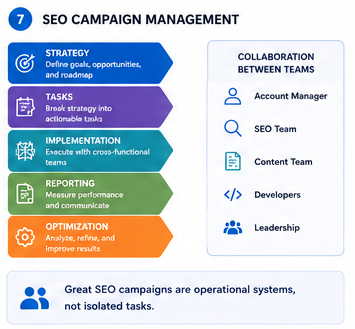 This is where many campaigns break down.
Without clear systems:
- Tasks become siloed
- Implementation slows down
- Priorities become unclear
- Stakeholders lose visibility
- Reporting becomes disconnected from action
SEO campaign management includes:
- Workflow coordination
- Implementation tracking
- Stakeholder communication
- Timeline management
- Reporting reviews
- Cross-functional collaboration
Common SEO Workflow Tools
- Google Drive
- Google Docs
- Google Sheets
- Project management systems
- SEO dashboards
Strong campaign management helps agencies, account managers, and SEO teams create more organized and scalable operations while improving the overall SEO effort. If your teams are struggling to execute SEO, you might want to invest in an SEO workflow assessment to streamline your processes.
What Should Be Included in SEO Reporting?
SEO reporting should explain performance, identify opportunities, and guide future optimization.
Many SEO reports overwhelm stakeholders with disconnected metrics that lack context or actionable insights.
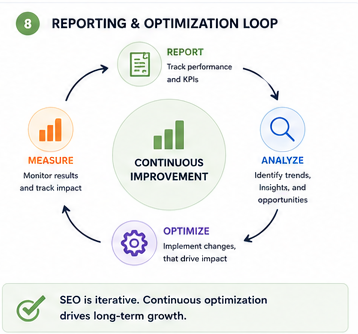 Effective SEO reporting focuses on:
- Organic visibility
- Traffic trends
- Conversions
- Engagement
- Keyword position tracking and movement
- Ai visibility signals
- Technical performance
- CTR analysis
- Content performance
Strong SEO Reports Should Answer:
- What improved?
- What declined?
- Why did it happen?
- What should happen next?
Common SEO Reporting Tools
- Semrush My Reports
- Looker Studio
- Google Analytics
- Google Search Console
Good reporting creates alignment between SEO teams, clients, leadership, and account managers.
Why Are Ongoing SEO Optimizations Important?
SEO is iterative.
Even strong-performing pages decline over time as:
- competitors improve
- search intent shifts
- SERPs evolve
- AI Overviews influence clicks
- content becomes outdated
Ongoing optimization helps maintain and improve visibility over time.
This phase often includes:
- CTR analysis
- title optimization
- content refreshes
- FAQ expansion
- entity optimization
- internal linking improvements
- SERP analysis
One of the most overlooked SEO opportunities is improving underperforming pages that already have ranking potential within the search engine results.
What Is a Deep-Dive SEO Page Analysis?
Deep-dive page analysis evaluates why specific pages underperform despite having visibility potential.
This process analyzes:
- Search intent mismatch
- Weak topical depth
- Semantic gaps
- Low engagement
- Poor internal linking
- Weak CTR
- Outdated information
- Entity deficiencies
This stage often uncovers opportunities that surface-level audits miss.
Instead of endlessly creating new content, teams can often improve visibility by refining and strengthening existing pages.
Sometimes the highest ROI SEO strategy is optimization, not expansion.
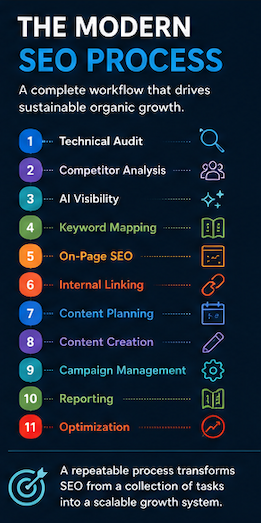
What Does a Modern SEO Workflow Look Like?
A modern SEO workflow connects technical SEO, AI visibility, content strategy, reporting, and optimization into one continuous operational process.
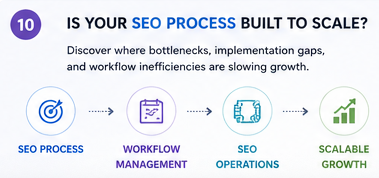 The workflow often looks like this:
- Technical crawl and audit
- Competitor ranking analysis
- AI visibility reporting
- Keyword mapping
- On-page optimization
- Internal linking
- Content planning
- Content creation
- Campaign management
- Reporting
- Ongoing optimization and CTR analysis
- Deep-dive page analysis
When these stages work together cohesively, SEO campaigns become more scalable, measurable, collaborative, and sustainable.
Understanding these workflows is an important part of learning the SEO basics while also building more advanced operational systems for long-term growth.
FAQs About the SEO Process
- What is the first step in the SEO process?
The first step is typically a technical SEO audit to identify crawlability, indexing, and site performance issues before moving into strategy and content development. - Why is SEO considered an ongoing process?
SEO is ongoing because search behavior, competitors, algorithms, AI search experiences, and content performance continuously evolve over time. - What tools are commonly used during SEO campaigns?
Common tools include Semrush, Google Search Console, Google Analytics, Looker Studio, Google Sheets, and Microsoft Excel. Many agencies also rely on at least one dedicated SEO tool for technical analysis and reporting. - Why is AI visibility important for SEO?
AI visibility helps brands understand how they appear across AI-powered search experiences and answer engines that increasingly influence organic discovery. - What is keyword mapping in SEO?
Keyword mapping organizes keywords, search intent, and target pages into a structured framework that supports topical authority and prevents keyword cannibalization. - Why do SEO campaigns fail?
SEO campaigns often fail because of disconnected workflows, unclear priorities, siloed communication, delayed implementation, and lack of cohesive strategy. - What is the difference between SEO strategy and SEO execution?
SEO strategy defines priorities, workflows, and goals. SEO execution involves implementing technical fixes, optimizing pages, creating content, and managing ongoing improvements. - How often should SEO reporting happen?
Most SEO campaigns benefit from monthly reporting combined with continuous monitoring for technical issues, rankings, traffic shifts, and optimization opportunities. - How do SEO services support long-term growth?
Professional SEO services help organizations improve visibility, strengthen technical performance, create strategic content, and build sustainable organic growth over time.