

What Are SEO Operations?
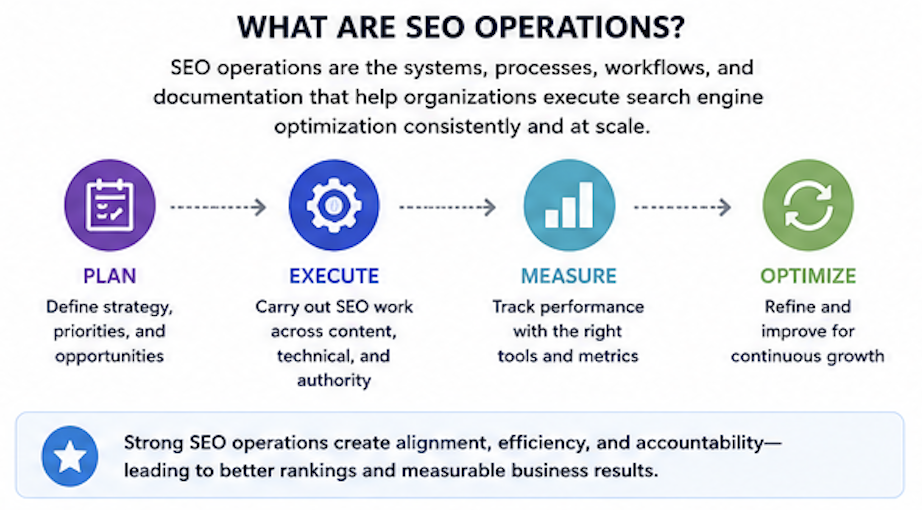
SEO operations are the systems, processes, workflows, documentation, and governance frameworks that enable organizations to execute search engine optimization consistently and at scale.
In simple terms, SEO operations are what turn strategy into action.
Many companies invest heavily in keyword research, content creation, technical SEO, and reporting. Yet they still struggle to improve their visibility in a search engine because execution becomes fragmented across departments.
 The strategy exists.
The SEO work does not get completed efficiently.
This is where SEO operations come in.
Strong SEO operations create structure around every aspect the SEO process, from planning and resource allocation to reporting and continuous optimization. They ensure teams can execute effective SEO consistently rather than relying on individual effort or institutional knowledge.
Why Are SEO Operations Important?
Most organizations don’t have a strategy problem. They have an execution problem.
Content gets held up in approval cycles. Development teams prioritize competing initiatives. Marketing campaigns launch without a clear understanding of user intent. Technical SEO recommendations go unimplemented, and reporting becomes disconnected from business outcomes.
As organizations grow, these gaps widen, creating silos, slowing progress, and making it harder to turn strategy into measurable results.
SEO operations help solve these challenges by creating repeatable systems that align stakeholders, establish accountability, and improve efficiency.
The result is:
- Better collaboration
- Faster implementation
- Improved content quality
- More consistent search ranking improvements
- Greater visibility in search engine results
- Stronger long-term SEO success
Without operational structure, even the best SEO tactics often fail to produce meaningful results.
How Do SEO Operations Differ From SEO Strategy?
SEO strategy defines what an organization wants to achieve and why. SEO operations determine how that strategy is executed.
For example, an SEO strategy might focus on increasing organic search visibility through content marketing and technical improvements. SEO operations establish the workflows, templates, timelines, responsibilities, and reporting systems needed to turn that strategy into action.
Think of SEO strategy as the blueprint for a successful campaign. The SEO process connects that blueprint to the work that needs to happen, while SEO operations provide the people, resources, project management, and systems required to bring it to life.
Strategy sets the direction. Process defines the path. Operations make it happen.
What Are the Core Components of SEO Operations?
Successful SEO operations typically consist of several interconnected components.
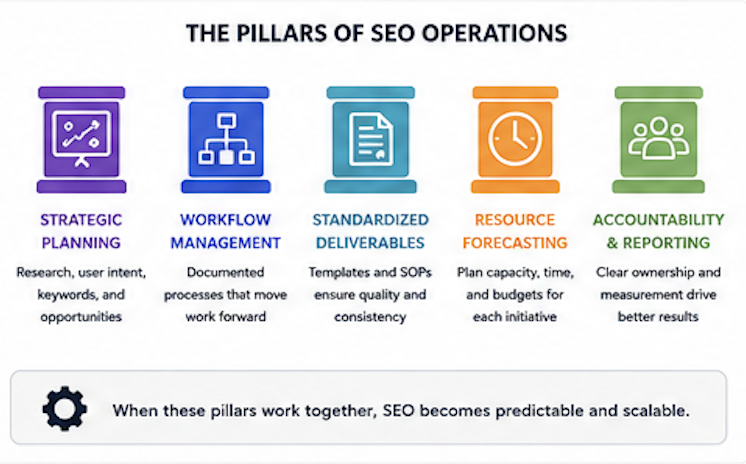
Strategic Planning
Every initiative should begin with a documented roadmap that outlines priorities, goals, opportunities, and expected outcomes.
This often includes:
- Keyword Mapping
- Competitive analysis
- User intent research
- Content strategy and planning
- Technical priorities
- Local SEO initiatives (if applicable)
 Without a centralized SEO process, teams often chase disconnected activities that fail to support business objectives.
SEO Workflow Management
SEO workflow management is the operational framework that moves projects from planning to completion.
Effective workflows define:
- Responsibilities
- Deadlines
- Deliverables
- Approval processes
- Reporting requirements
Organizations that invest in workflow management reduce bottlenecks and improve accountability across teams.
Get Your SEO Workflow Checklist
Standardized Deliverables
One of the most overlooked aspects of SEO operations is standardization.
Every major initiative should have a documented process and template.
Examples include:
- SEO audit templates
- Technical SEO recommendations
- Page SEO deliverables
- Content briefs
- Reporting dashboards
- Internal linking plans
Standardized deliverables improve consistency while making onboarding and training significantly easier.
Resource Forecasting
Many organizations underestimate the importance of planning capacity.
Successful SEO operations forecast the time and resources required for each initiative.
This helps teams:
- Manage workloads
- Improve profitability
- Set realistic timelines
- Align expectations
Every SEO effort should have a defined scope, owner, and estimated level of effort (hours) and a target hourly rate for agencies.
How Do SEO Operations Improve Search Performance?
Search performance is rarely the result of one successful tactic.
Instead, it comes from consistent execution across multiple disciplines.
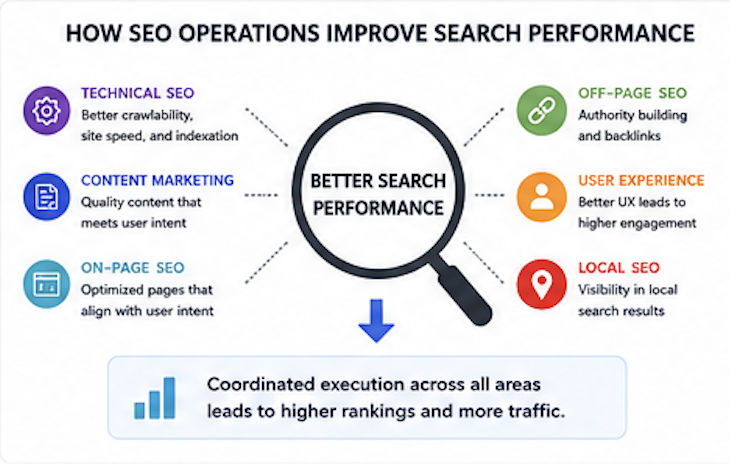
Strong SEO operations help organizations coordinate:
- Technical SEO
- Content marketing
- Off page SEO
- Image SEO
- User experience improvements
- Local SEO optimization
This creates a more efficient process for improving visibility across search engine results pages.
When teams execute consistently, organizations are more likely to achieve sustainable ranking improvements over time.
What Role Does Technology Play in SEO Operations?
Technology supports SEO operations, but it does not replace them.
Many organizations mistakenly believe purchasing more SEO tools will solve execution challenges.
Tools help.
Systems create results.
Common technologies used in SEO operations include:
- Semrush (content planning, keyword research, reporting and more)
- Google Analytics
- Google Search Console
- Google Keyword Planner
- Project management platforms
- Reporting software
- Content optimization platforms
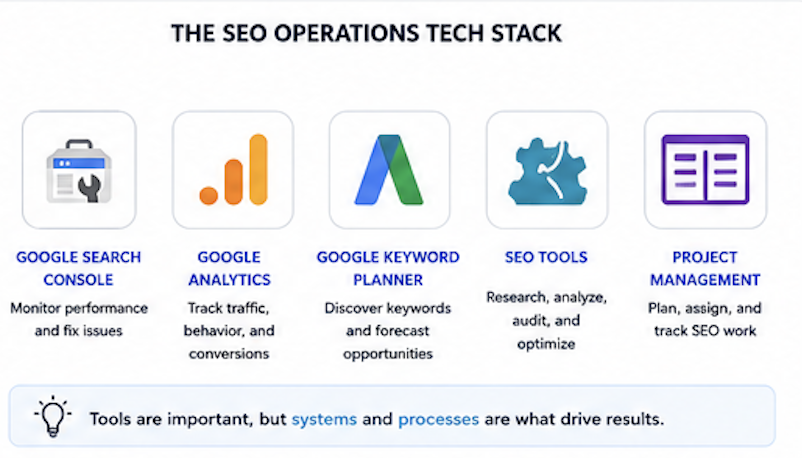
A quality SEO tool like Semrush can help uncover opportunities and monitor performance, but success still depends on processes, accountability, and execution.
The most successful organizations build workflows first and select SEO tools that support those workflows.
How Do SEO Operations Support Cross-Functional Teams?
SEO touches nearly every area of modern digital marketing.
Teams involved in SEO often include:
- Content creators
- Developers
- UX specialists
- Analytics teams
- PR professionals
- Social media teams
- Marketing leadership
Without operational structure, communication becomes fragmented.
SEO operations establish clear ownership and documented processes that help departments work toward the same goals.
For example:
- Content teams understand content requirements.
- Developers understand technical priorities.
- Analytics teams understand measurement frameworks.
- Leadership understands expected outcomes.
- This alignment helps reduce friction while improving execution quality.
What Is the Relationship Between SEO Workflow Management and SEO Operations?
SEO workflow management is one component of SEO operations.
Workflow management focuses specifically on how projects move through an organization.
SEO operations encompass the larger system.
This includes:
- Strategy
- Deliverables
- Workflow management
- Forecasting
- Accountability
- Reporting
- Governance
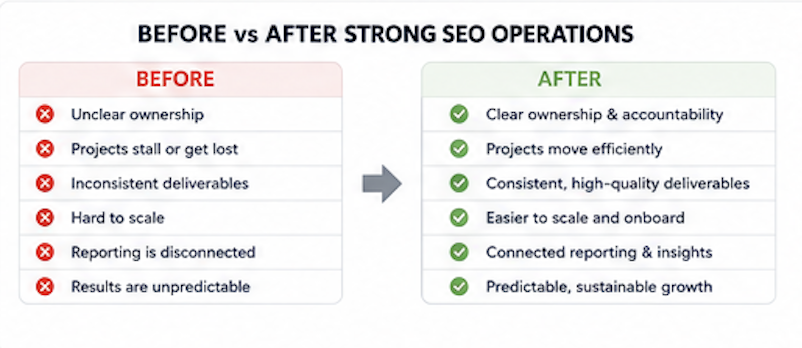
Organizations that master workflow management often create stronger SEO operations because projects move efficiently from planning to implementation.
In many cases, workflow management becomes the foundation for operational maturity.
How Can Organizations Build an SEO Operations Framework?
Building SEO operations starts with documentation.
Step 1: Audit Current Processes
Identify how SEO initiatives currently move through the organization.
Look for:
- Bottlenecks
- Delays
- Communication gaps
- Ownership issues
- Standardized templates
Step 2: Create Standardized Templates
Document repeatable deliverables.
Examples include:
- Technical audits
- Keyword research
- Content briefs
- SEO optimization recommendations
- Reporting dashboards
Step 3: Define Ownership
Every initiative should have a clearly assigned owner.
Without ownership, projects often stall.
| Team | Primary SEO Ownership |
|---|---|
| Executive Sponsor | Provides budget, removes roadblocks, aligns SEO with business objectives, approves major initiatives |
| Account Manager | Owns client communication, manages expectations, coordinates deliverables, facilitates stakeholder alignment |
| SEO Team | Strategy, keyword research, technical audits, workflow management, optimization, reporting |
| Content Team | Content creation, content updates, content briefs, subject matter expertise |
| Development Team | Technical implementation, site architecture, page speed, schema, indexing improvements |
| UX Team | User experience, conversion optimization, navigation, engagement improvements |
| PR Team | Authority building, digital PR, brand mentions, backlink acquisition |
| Social Media Team | Content amplification, audience engagement, campaign support |
| Analytics Team | Measurement, dashboards, attribution, forecasting, KPI tracking |
| Sales / Business Development | Shares customer insights, identifies customer pain points, provides feedback on lead quality |
Step 4: Implement Workflow Systems
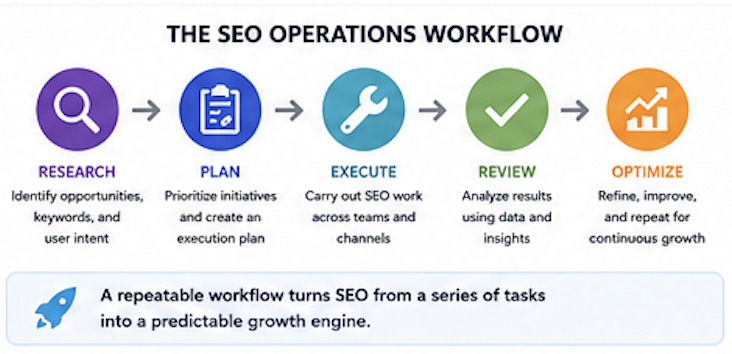
Build repeatable workflows that guide projects from planning to execution.
Step 5: Measure Performance
Track both operational metrics and SEO outcomes.
This may include:
- Publishing velocity
- Implementation speed
- Search engine ranking improvements
- Traffic growth
- Conversion performance
What Do High-Performing SEO Teams Understand That Others Miss?
High-performing organizations understand that SEO is more than a marketing channel. It is an operational function that requires coordination across teams, clearly defined processes, and consistent execution.
Rather than relying on individual effort to move initiatives forward, the strongest teams build systems that make execution predictable, repeatable, and measurable.
They document processes so teams understand how work gets done. They standardize deliverables to improve consistency and quality. They establish clear ownership and build workflows that help SEO recommendations move from planning to implementation.
The result is an SEO function that can scale with the organization, adapt to changing priorities, and connect strategic goals to measurable business outcomes.
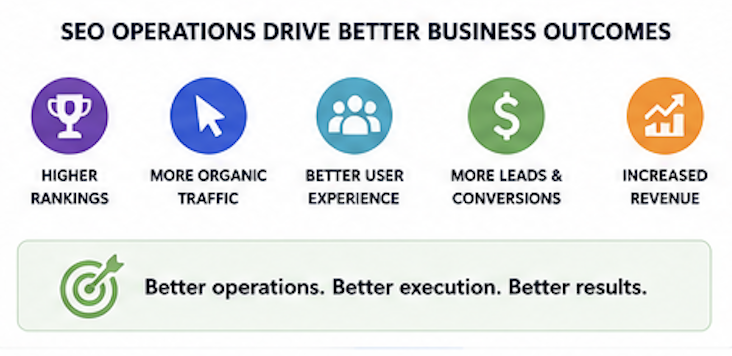
They plan resources around priorities, prepare stakeholders to understand their role in SEO, and measure performance against meaningful business outcomes. They also build scalable frameworks that can be adapted as the organization grows.
By creating structure and clarity around how SEO work gets done, teams reduce friction, improve efficiency, and support sustainable growth.
Rather than relying on individual expertise or ad hoc efforts, high-performing organizations build the operational infrastructure needed to deliver consistent results over the long term
How Do SEO Operations Support Other Marketing Channels?
Strong SEO operations create benefits that extend beyond organic search.
When teams develop quality content and improve site architecture, those improvements often support:
- Search engine marketing initiatives
- Google Ads campaigns
- Social media promotion
- Brand visibility
- Customer acquisition efforts
This creates a more integrated digital marketing strategy.
Organic and paid channels become more aligned, resulting in better overall performance.
Final Thoughts
Most organizations know SEO requires strategy. Fewer recognize that strategy alone doesn’t deliver results.
SEO recommendations don’t implement themselves. Content doesn’t get published without coordination. Technical improvements don’t happen without development resources. And reporting doesn’t create value unless it informs decisions.
The real challenge isn’t just knowing what needs to be done. It’s building an organization capable of doing it.
That requires more than SEO expertise. It requires aligned teams, clear ownership, realistic resource planning, and repeatable processes that move work from recommendation to implementation.
SEO operations provide the structure that connects these moving parts, turning individual efforts into coordinated execution and strategic priorities into measurable business outcomes.
Because the difference between an SEO strategy that sits in a presentation and one that drives growth isn’t always the strategy itself. It’s the organization’s ability to execute.
Start by auditing your current SEO workflow. Identify where recommendations stall, where ownership is unclear, and where teams lack the resources or processes to move work forward. Then prioritize the operational gaps that have the greatest impact on your ability to deliver results.
The goal isn’t simply to do more SEO. It’s to build a system that helps the entire organization do the right SEO work, consistently, collaboratively, and with measurable impact.
Frequently Asked Questions About SEO Operations
What are SEO operations?
SEO operations are the processes, systems, workflows, and governance frameworks that help organizations execute SEO consistently and efficiently.
How are SEO operations different from SEO strategy?
SEO strategy defines goals and priorities, while SEO operations focus on how those goals are executed and managed.
Why are SEO operations important?
SEO operations improve accountability, reduce bottlenecks, streamline communication, and help organizations achieve more consistent SEO success.
What tools are used in SEO operations?
Common tools include Google Search Console, Google Analytics, Google Keyword Planner, Google Workspace, reporting platforms, content optimization software, and project management systems.
How do SEO operations improve search rankings?
SEO operations improve consistency and execution quality across technical SEO, content creation, optimization, and reporting, which helps improve search ranking performance over time.
Can small businesses benefit from SEO operations?
Yes. Even simple workflows and documented processes can help small businesses improve efficiency, reduce mistakes, and create a stronger foundation for organic growth.
Are SEO operations only for enterprise companies?
No. While enterprise organizations often have more complex needs, businesses of all sizes can benefit from creating repeatable systems for SEO execution.
How do SEO operations support local SEO?
SEO operations help standardize activities such as Google Business Profile optimization, local content creation, citation management, and reporting, making local SEO efforts more efficient and scalable.
