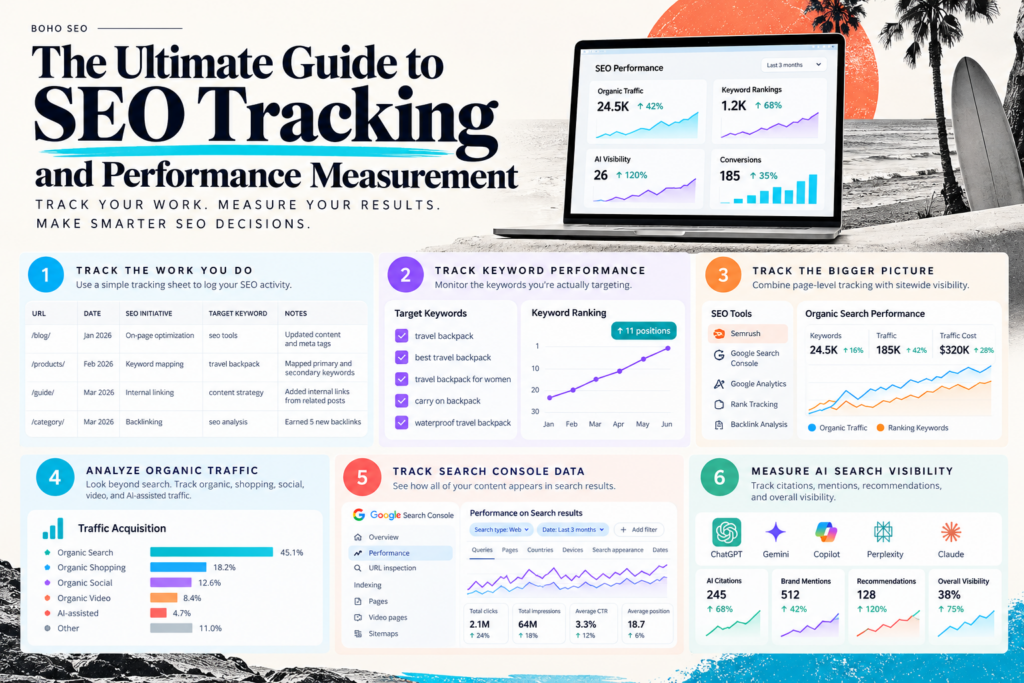

SEO tracking is more than watching your rankings move up and down. A strong SEO tracking system helps you understand what is happening in search, why it is happening, and whether your SEO efforts are contributing to meaningful business results.
That means looking beyond a single keyword ranking or a monthly organic search traffic number.
Effective SEO tracking connects three things:
What you did → What happened in search → What happened to the business
By combining keyword tracking, Google Search Console, Google Analytics, position tracking, and broader SEO data, you can move beyond simply reporting SEO results and start understanding them.
This guide covers how to build an SEO tracking system that helps you measure SEO progress, diagnose changes, and make better decisions about your SEO strategies.
Track the Work You Do, Not Just the Results
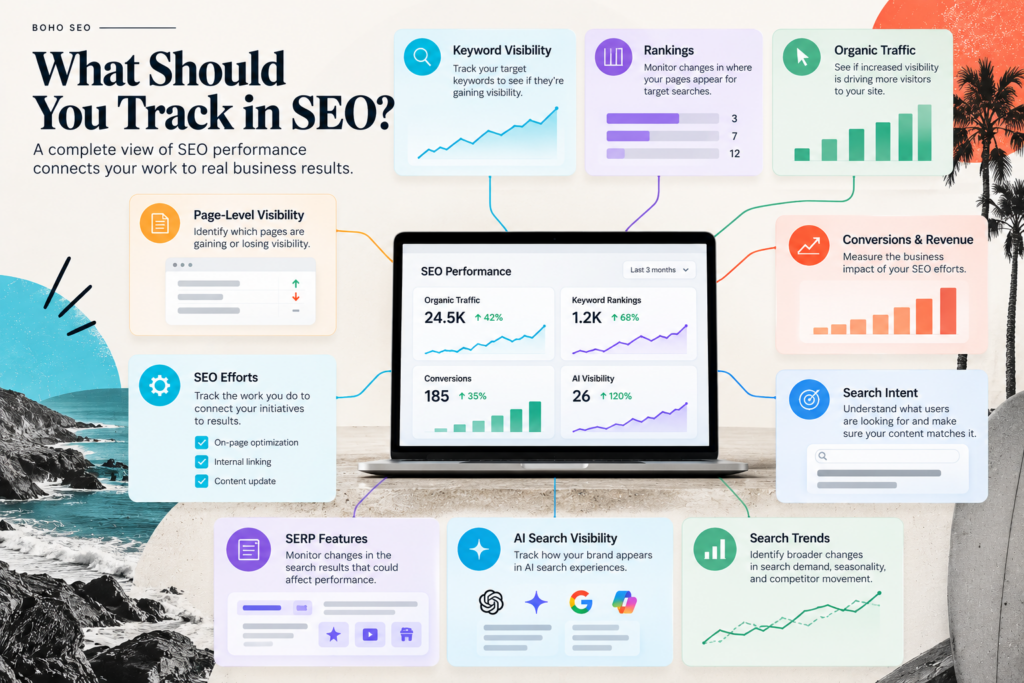
One of the most useful SEO tracking systems you can create is also one of the simplest: a spreadsheet.
A Google Sheet can become a running record of the URLs you work on, when you worked on them, and what type of SEO initiative you completed.
At a minimum, I recommend tracking:
| URL | Month Worked | SEO Initiative |
|---|---|---|
| /example-page | January 2026 | On-page optimization |
| /another-page | January 2026 | Internal linking |
| /new-blog | February 2026 | New blog |
| /product-page | February 2026 | Keyword mapping |
| /guide | March 2026 | Backlinking |
You can add additional columns for the target keyword, search intent, content type, notes, or the person responsible for the work.
The important thing is to create a historical record of your SEO efforts.
Why Track Your SEO Initiatives?
Because it allows you to connect performance changes back to the work that was actually done. It helps show the value of your work and helps stakeholders see the ROI in investing in your SEO work. Doing so builds trust with your clients and trust is the foundation for a partnership and retention.
For example, if organic search traffic increases for a group of pages in March, you can look back at your tracking sheet and see whether those pages received:
- Keyword mapping
- On-page optimization
- Internal linking
- Backlinks
- New content
- Content updates
Now your SEO reporting can answer more useful questions:
- What did we change before performance improved?
- Which SEO initiatives are producing the strongest results?
- Which pages have we worked on that haven’t moved yet?
- Are the improvements happening on the URLs we actually prioritized?
This creates a connection between your SEO campaigns and your SEO results that is often missing from standard reporting.
Instead of simply saying, “Organic traffic increased 15%,” you can begin to understand what work may have contributed to that increase.
Build a Focused Keyword Tracking Strategy
Keyword tracking is one of the most common forms of SEO monitoring, but more isn’t necessarily better.
Keyword tracking tools make it easy to collect thousands of keywords, but tracking too many can become expensive and make your reporting harder to understand.
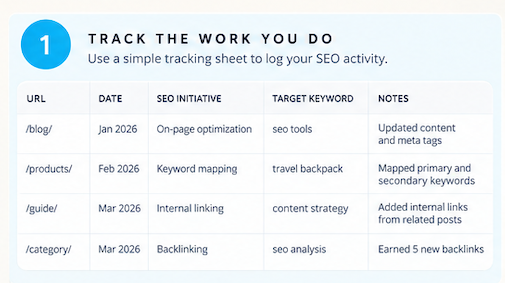
I recommend starting with the keywords you’ve intentionally identified through your keyword research and mapping process. These are the terms you’re actively trying to improve visibility for.
Then, connect those keywords to your SEO tactics and the month the work was completed in your URL tracker. For example, tag pages with tactics such as keyword mapping, on-page optimization, internal linking, backlinking, or content refreshes.
This creates a connection between what you did and what happened afterward, helping you identify which tactics are working and which may need to be refreshed.
Your keyword tracking should help you answer more than “Did rankings change?” It should help you understand what changed, what you did, and what worked.
Track the Keywords You’re Actually Targeting
When you create a keyword map for a page, use that research to determine your tracked keywords.
If you’ve optimized a product page around a primary target keyword and several closely related terms, those are the keywords you should prioritize in your rank tracking.
You don’t need to track every keyword variation Google associates with the page.
Your tracking tool should answer a specific question:
Are the keywords we’re targeting for the pages we’ve worked on gaining visibility?
That is much more useful than simply watching hundreds of unrelated rankings move around.
Keep Your Keyword Tracking Focused
A focused set of tracked keywords gives you a cleaner picture of your SEO progress. It also makes it easier to connect keyword ranking changes to specific SEO initiatives.
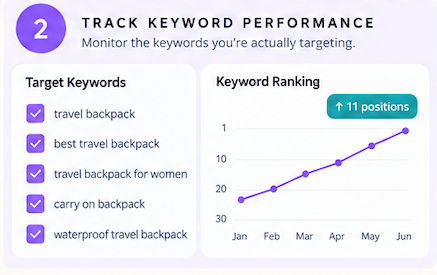
For example:
Target keyword: travel backpack
URL: /travel-backpacks
SEO initiative: On-page optimization
Month optimized: June
Position before: 18
Current position: 7
Now you have a measurable connection between the page, the keyword, the SEO effort, and the ranking.
That’s useful SEO tracking. You can add keyword tags in Semrush to keep track of the month and SEO deliverable you worked on. This also helps with identifying which tactic your site responds well to.
Use Both Page-Level and Domain-Level Rank Tracking
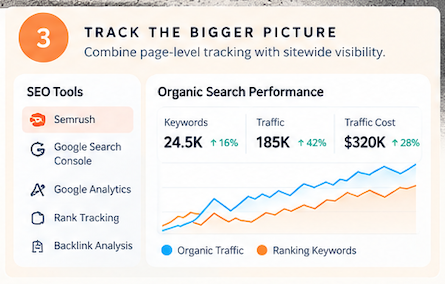
While focused keyword tracking is important, you also need to zoom out. There are two different levels of analysis you should be reporting on and looking at.
Page-level SEO rank tracking
Are the tracked keywords for the pages you’ve worked on improving?
Domain-level SEO tracking
Is the website’s overall organic visibility improving?
Both perspectives matter.
Your rank tracker or position tracking tool can help you monitor your priority keywords, while broader tools such as Semrush can help you understand overall domain performance.
The domain-level view can reveal changes in:
- Overall keyword visibility
- Organic search traffic
- Number of ranking keywords
- Keyword distribution across positions
- Competitor visibility
- Search trends
- Search engine result pages
This prevents you from focusing so heavily on individual keyword rankings that you lose sight of what is happening across the entire domain.
Don’t Treat Ranking as the Same Thing as SEO Success
Keyword ranking is an important part of SEO tracking, but a ranking by itself doesn’t tell you whether your SEO efforts were successful.
For example, moving a page from position 20 to position 8 is a meaningful change. But the ranking is really the starting point for a deeper analysis.
What happened after the page moved?
- Did organic search traffic increase?
- Did the page attract the right search intent?
- Did users engage with the page or convert?
- Did organic revenue increase?
- Did the page begin appearing for additional relevant searches?
- Did the page strengthen the visibility of other pages through internal linking?
These questions help put a ranking change into context.
A page can improve its keyword ranking without producing meaningful business results. It can also generate valuable organic traffic without holding a top position for a single keyword. And sometimes a page’s value isn’t measured by its own traffic at all. It may support a larger topic cluster, strengthen internal linking, or help establish visibility across a broader set of searches.
That’s why I recommend looking at keyword rankings alongside traffic, search intent, conversions, revenue, page-level performance, and the SEO work that contributed to the change.
A ranking report tells you where you appear.
SEO analysis helps you understand what that visibility means.
Use Google Analytics to Connect SEO to Business Results
Google Analytics helps you understand what happens after someone arrives on your website. When measuring SEO performance, don’t stop at organic search traffic.
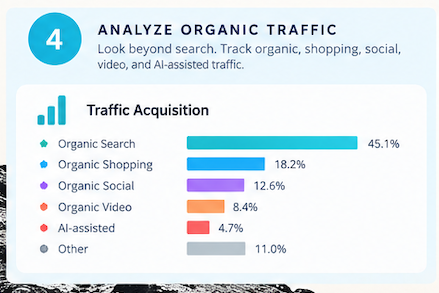
Depending on your business and content strategy, your reporting may include:
- Organic search
- Organic shopping
- Organic social
- Organic video
- AI-assisted traffic
- Conversions
- Revenue
- Engagement
- Landing-page performance
Google Analytics now includes an AI-assisted traffic segment, allowing you to monitor traffic from AI platforms alongside traditional acquisition channels.
AI-assisted traffic may still be relatively small for many businesses, but volume isn’t the only metric that matters. For some ecommerce businesses, AI-assisted traffic is already contributing to revenue.
The more important questions are:
Does AI-assisted traffic engage? Does it convert? Does it generate revenue?
Looking beyond traffic volume helps you determine whether AI search visibility is becoming commercially meaningful.
Expand Google Search Console Beyond Traditional Search Reporting
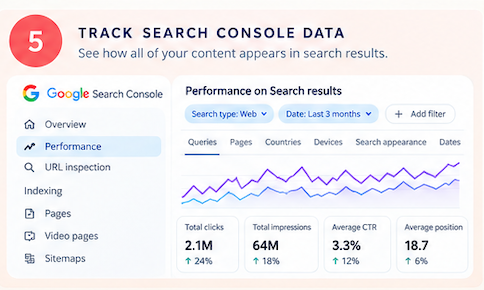
Google Search Console is one of the most valuable sources of SEO data available to website owners.
It can help you understand:
- Search queries
- Impressions
- Clicks
- Click-through rate
- Average position
- Pages appearing in search
- Search performance over time
 But your search visibility doesn’t necessarily begin and end with your website’s traditional Google Search results.
If your brand has an active presence on YouTube, Instagram, TikTok, or X, connect those properties to Google Search Console where supported.
This can give you another way to understand how your broader content ecosystem appears in search results.
For example, if you’re recommending YouTube videos or Instagram content as part of an SEO strategy, you should have a way to understand whether that content is contributing to search visibility.
This is especially useful when your SEO strategy includes content across multiple platforms.
You may have:
Blog → YouTube → Instagram → Google Search → AI search
Instead of treating each channel as an isolated marketing activity, you can begin to understand how those assets work together.
That broader view becomes increasingly important as search continues to expand beyond the traditional search engine result pages.
Measure Search Intent, Not Just Keywords
Keywords tell you what someone searched. Search intent helps you understand what they were trying to accomplish.
That distinction matters when evaluating SEO performance. A page can rank for hundreds of keywords and still attract traffic that has little value if those searches don’t align with the page or the user’s needs.
For example, an ecommerce product page might rank for informational searches that generate traffic but few sales, while a smaller set of commercial searches may bring fewer visitors but significantly more qualified traffic and revenue.
That’s why keyword volume shouldn’t be the goal on its own.
Your SEO tracking should connect:
Keyword → Search intent → Page → Conversion
The goal isn’t to rank for more keywords. It’s to attract the right searchers to the right pages and understand what happens after they arrive.
Start Measuring AI Search Visibility
AI search is becoming another part of the search ecosystem, which means SEO tracking needs to evolve with it. Traditional SEO rank tracking tells you where a website appears in Google’s search results.
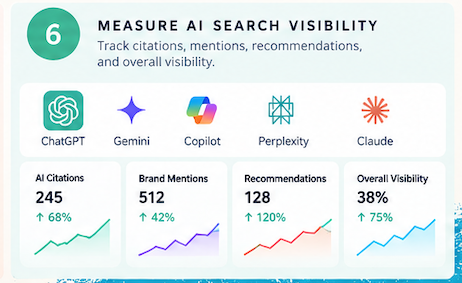
AI search measurement asks different questions:
- Is the brand being mentioned?
- Is the brand being cited?
- Is the brand being recommended?
- Which sources are AI platforms using?
- Which competitors are appearing alongside the brand?
- Is visibility increasing or decreasing over time?
I’m currently developing an AI measurement framework to help answer these questions.
| AI visibility signal | What to monitor |
|---|---|
| AI Citations | How often your website or other owned content is cited as a source in AI-generated answers. |
| Brand Mentions | How frequently your brand is mentioned in AI-generated responses. |
| Recommendations | Whether your brand is included when users ask AI platforms for recommendations within your category. |
| Overall AI Visibility | How visible your brand is across the AI search environments you’re monitoring. |
It should become another layer of it.
Look Beyond Rankings and Traffic
One of the biggest mistakes in SEO reporting is treating a single metric as the complete story. SEO performance exists within a larger system, and the relationship between metrics often provides more insight than any metric on its own.
| What you see | What it could mean | What to investigate |
|---|---|---|
| Rankings increase, but CTR decreases | Search results may have changed, or SERP features may be capturing more attention. | SERP features, search result changes, query mix |
| Organic traffic decreases, but conversion rate and revenue increase | You may be attracting fewer but more qualified visitors. | Traffic quality, search intent, conversion performance |
| Rankings increase, but organic traffic remains flat | Search demand may have changed, or fewer clicks may be available from the SERP. | Search demand, search intent, SERP features, changes to the search experience |
The point is simple: no single metric can explain SEO performance by itself.
One metric tells you what happened. The relationship between metrics helps you understand why.
Use SEO Data to Understand What Changed
When something changes in your SEO performance, resist the temptation to immediately change your strategy. Start by understanding the change.
| Question | What to examine |
|---|---|
| What changed? | Rankings, impressions, clicks, traffic, conversions, revenue, or AI visibility |
| Where did it change? | URLs, keywords, topics, content types, or sections of the website |
| Why did it change? | Algorithm updates, search demand, seasonality, SERP changes, competitor movement, technical SEO issues, content changes, search intent, or changes to the search experience |
| Did it affect the business? | Conversions, revenue, leads, or other business outcomes |
| What should we do next? | Determine whether the data supports a strategic or tactical change |
Don’t just report what changed. Understand why it changed, determine whether it matters to the business, and use that insight to decide what to do next.
Turn SEO Tracking Into SEO Strategy
The ultimate purpose of SEO tracking isn’t to produce a bigger dashboard.
- It’s to make better decisions.
- If organic search traffic is declining, investigate where the decline is occurring before deciding what to change.
- If rankings are improving but traffic isn’t, look at search demand, CTR, SERP features, and changes to the search experience.
- If traffic is declining while conversion rate and revenue are increasing, don’t automatically assume the SEO strategy is failing.
- If AI visibility is increasing but AI-assisted traffic remains relatively small, establish the baseline and continue monitoring how that relationship develops.
- And if a group of URLs suddenly loses visibility during an algorithm update, use your SEO activity log to determine whether those pages had anything in common with the SEO work you performed.
The goal is to move from:
“Our rankings changed.”
to:
“These pages changed, these keywords changed, this is what we did to them, this is what changed in the search environment, and this is what happened to the business.”
That’s the difference between SEO reporting and SEO analysis.
What Does Good SEO Tracking Look Like?
A strong SEO tracking system connects four layers of information:
| Layer | Question | What to track |
|---|---|---|
| SEO Activity | What did we do? | URLs, dates, content updates, technical changes, and other SEO initiatives |
| Search Performance | What happened in search? | Rankings, impressions, clicks, CTR, organic traffic, search intent, SERP features, and AI visibility |
| User Behavior | What happened after people arrived? | Engagement, conversions, and revenue |
| Business Results | Did it matter? | Leads, sales, revenue, or other business outcomes |
When these layers are connected, SEO reporting becomes more than a collection of metrics. It creates a record of what you did, what happened, what you learned, and what to do next.
The Goal Isn’t More Data
There is no shortage of SEO tools, dashboards, and data. The challenge is knowing what to do with it.
A useful SEO tracking system should answer five questions:
- What changed?
- Why did it change?
- Did our SEO efforts contribute?
- Did it matter to the business?
- What should we do next?
By combining Google Search Console, Google Analytics, keyword and rank tracking, SEO activity tracking, and AI visibility measurement, you can build a more complete picture of SEO performance.
Good SEO tracking isn’t about more numbers. It’s about better insight.