

For years, SEO and social media have operated as separate marketing channels. SEO teams focused on search engines, rankings and website traffic, while social teams focused on social media content, engagement and brand awareness.
That distinction is becoming less useful.
People are searching across Google, YouTube, TikTok, Instagram and X to discover information, research products, find answers and evaluate brands. At the same time, social content is increasingly appearing beyond the social platform where it was originally published.
That creates a new opportunity for marketers: using search intelligence to inform social media strategy, while also measuring how social content performs in search.
The shift isn’t about replacing traditional social media marketing with SEO. It’s about adding another layer of intelligence to the social strategy.
Social Strategy Still Has Its Own Lane
Search intelligence shouldn’t take over the social media strategy.
Brands will always have content that exists for reasons beyond search: a product launch, a brand campaign, a cultural moment, a partnership, a company announcement or a piece of creative designed to build brand awareness.
Those efforts have their own lane, and they should.
A strong social media strategy should include a mix of:
- Branded content that communicates the company’s identity, campaigns and point of view
- Community-driven content informed by conversations, social listening and audience engagement
- Campaign content tied to specific business and marketing goals
- Search-informed content created around questions, topics and interests revealed through search intelligence
The opportunity is not to make every social post an SEO effort.
It’s to make some social content intentionally informed by search insights.
That distinction matters.
Search Intelligence Can Inform What You Post
Traditional social media planning often starts with a content calendar: What campaign is coming up? What product needs promotion? What should we post this week?
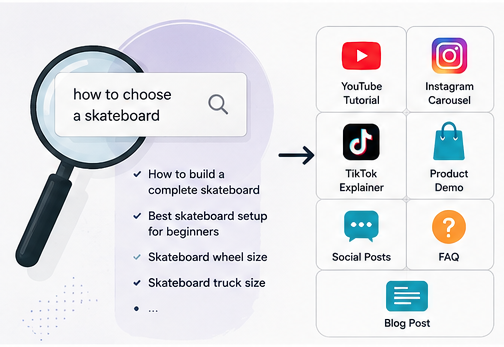 Search intelligence gives marketers another question:
What are people already looking for?
Search data can reveal the questions, problems, comparisons and topics people are actively exploring. Those insights can then influence social media posts across different social channels.
For example, imagine search research reveals demand around:
- How to choose a skateboard
- How to build a complete skateboard
- Best skateboard setup for beginners
- Skateboard wheel size
- Skateboard truck size
Those aren’t simply keywords for an SEO team to turn into a blog post.
They’re potential social media content.
The same search insight could inform:
- A YouTube tutorial
- An Instagram carousel
- A TikTok explainer
- A product demonstration
- A series of social posts
- An FAQ
- A longer-form blog post
The search query provides the insight. The social platform and format determine how the brand answers it.
This is the difference between simply repurposing content and using search intelligence to inform content planning from the beginning.
Social Search and Google Search Are Not the Same Thing
There’s an important distinction marketers need to make when talking about social media SEO.
Social search can mean searching within a social platform. Search visibility can also mean social content appearing in traditional search engines such as Google. And increasingly, social content can also contribute to how a brand is discovered or represented in AI and LLM platforms. These are related, but they aren’t the same search environment.
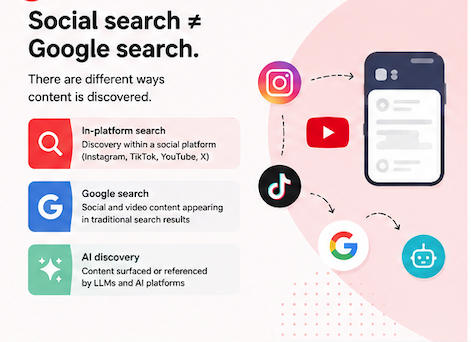
| Search environment | What you’re optimizing for | Example |
|---|---|---|
| In-platform social search | Discovery within a social platform | Someone searches Instagram for “travel backpack” |
| Google search | Visibility in a traditional search engine | An Instagram post or YouTube video appears in Google results |
| LLM / AI discovery | Being surfaced, referenced or associated with a topic by AI systems | Someone asks an AI platform for recommended travel backpacks |
| Website search / traditional SEO | Organic visibility for web pages | A brand’s product or blog page ranks in Google |
This means Instagram SEO isn’t necessarily the same thing as getting an Instagram post to appear in Google.
Instagram SEO can involve optimizing a social profile, captions, content topics and other signals to improve discoverability within Instagram’s own search environment.
Google search visibility is a different layer. Here, the question is whether that Instagram content can appear when someone searches Google.
The same distinction applies to YouTube SEO.
A YouTube video can be optimized to perform within YouTube’s search and recommendation ecosystem while also having the opportunity to appear in Google search results.
And there’s another layer emerging as social content becomes part of the broader information ecosystem: visibility in AI and LLM platforms.
The same content may therefore have multiple discovery paths:
Social search → Google search → AI discovery
Understanding those paths is becoming an important part of modern search strategy.
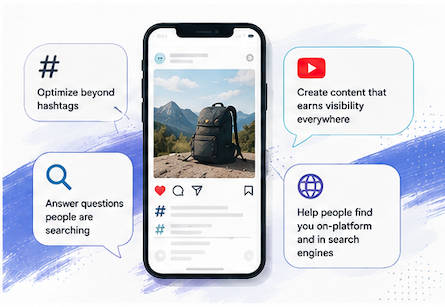
Social Media SEO Is Bigger Than Hashtags
Social media SEO has traditionally been associated with optimizing a social media profile, captions, hashtags and keywords within a particular social platform.
Those tactics still matter.
But social media SEO strategy can now extend beyond the platform itself.
A YouTube video can answer a search query. A TikTok can demonstrate a solution. An Instagram post can provide inspiration or reinforce a topic. An X post can contribute to a broader conversation.
That means social media content can have a life beyond the social feed.
For marketers, the opportunity is to consider both:
How do we help people find this content on the social platform?
and:
How can this content contribute to visibility across search engines and other discovery environments?
Those are different questions, but they can inform the same content strategy.
We Can Start Measuring Social Search Performance
This is where things get particularly interesting.
Traditional social media management and reporting typically focuses on metrics such as:
- Views
- Likes
- Comments
- Shares
- Followers
- Engagement rate
Those metrics remain useful. But they don’t tell us everything about search visibility.
Search performance data provides another layer of insight, including:
| Search signal | What it tells you |
|---|---|
| Video ranking data | Where video content is appearing in search |
| Related queries | What people are searching for in connection with the content |
| Impressions | How often content is being surfaced in search |
| Clicks | Whether search visibility is generating visits |
| Average position | How prominently content is appearing for relevant searches |
This gives marketers a way to begin thinking about social search performance alongside traditional social metrics.
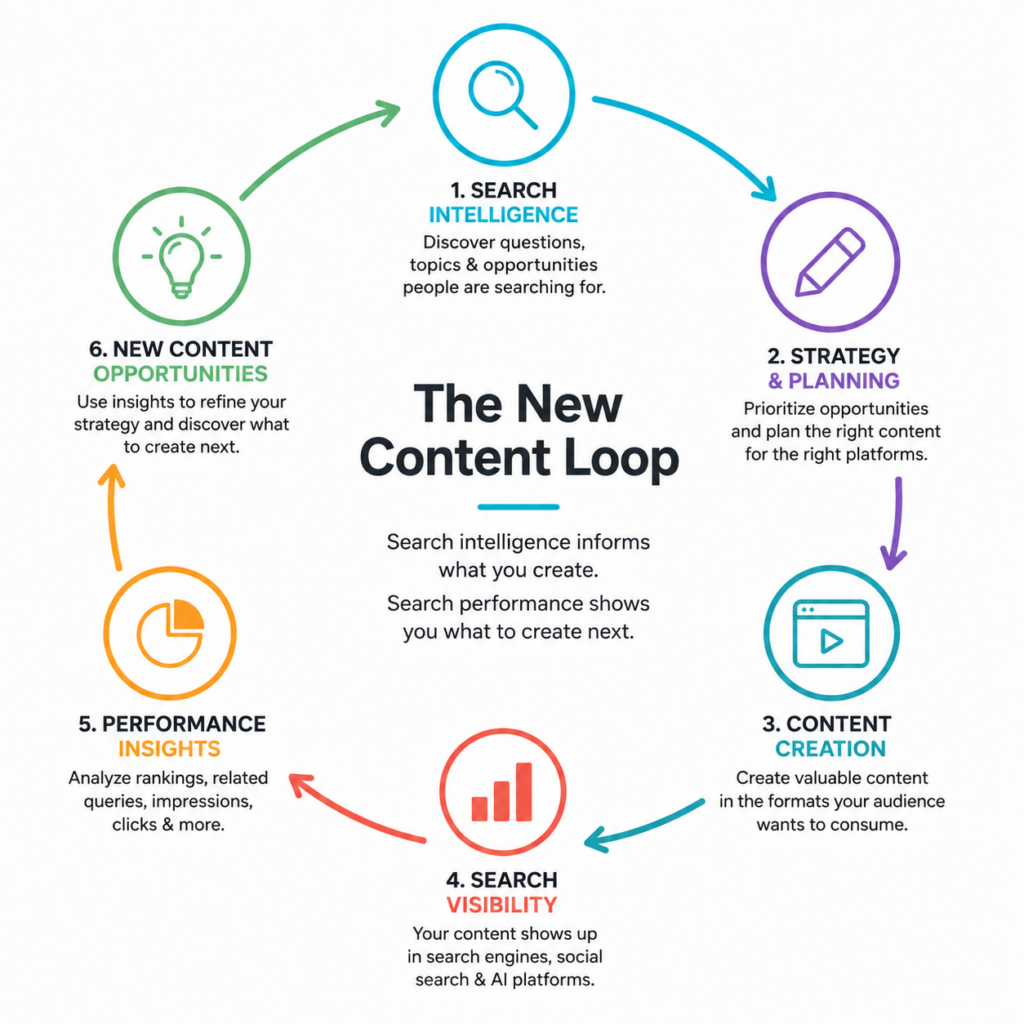
It also creates a feedback loop.
If a YouTube video starts ranking for related queries that weren’t part of the original social media campaign, those queries may reveal new content opportunities. If a topic consistently earns impressions and strong rankings, it may deserve more attention in the social media strategy.
The data isn’t simply reporting what happened.
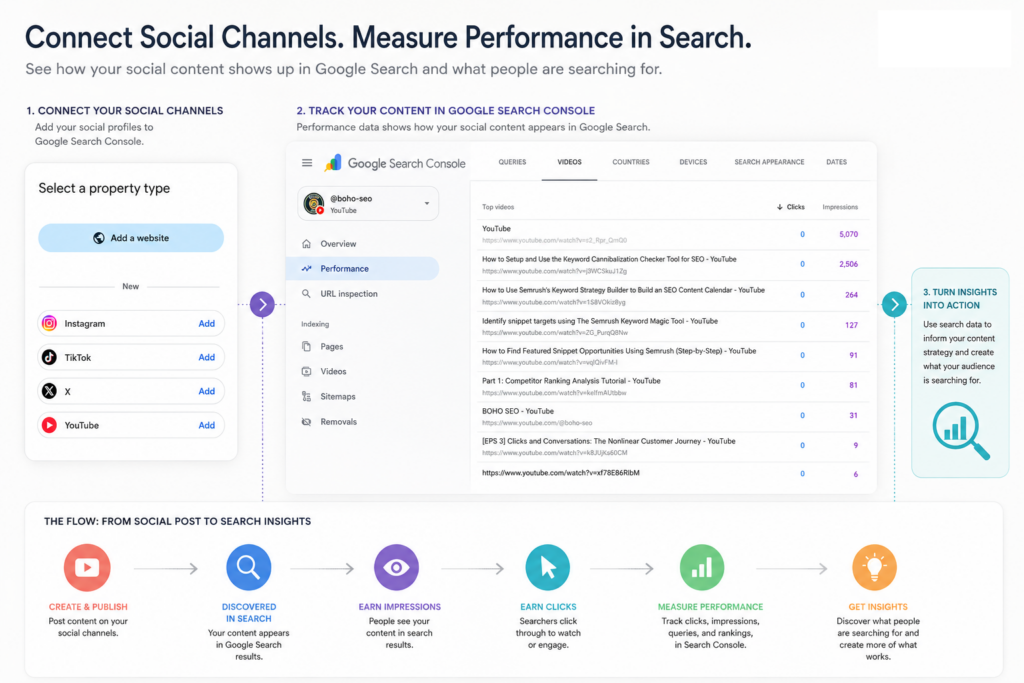
It’s helping inform what happens next.
From Content Repurposing to Search-Informed Content Planning
There’s a meaningful difference between these two approaches.
Traditional content repurposing
Blog post → Instagram post → YouTube video → TikTok
The content already exists, and the social team adapts it for different social platforms.
Search-informed content planning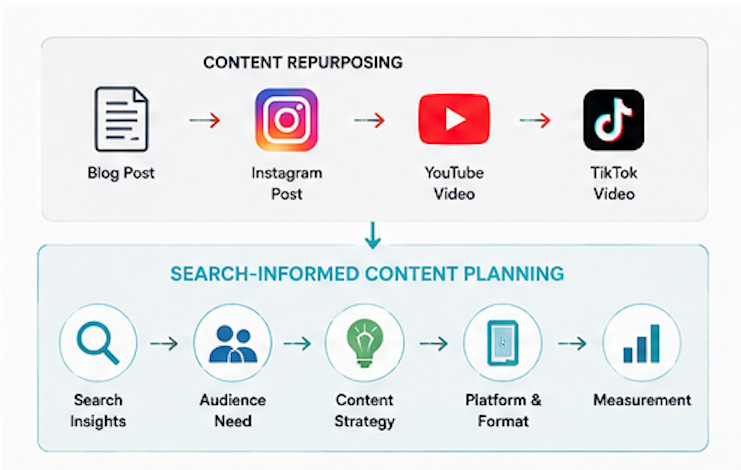
Search insights → audience need → content strategy → platform → format → measurement
Here, search intelligence influences the content idea before the social media post is created.
For example, if search research reveals that people want to understand how to choose the right travel backpack, that insight could inform an entire content theme:
- YouTube: How to Choose a Travel Backpack
- Instagram: 5 Things to Look for in a Travel Backpack
- TikTok: Three Backpack Features People Overlook
- Blog: Complete Travel Backpack Buying Guide
- Product content: Compare backpack features
- Social posts: Customer use cases and packing examples
The individual pieces can serve different purposes while being informed by the same underlying search insight.
That’s a more strategic use of search intelligence than simply turning a blog post into a social post.
Search Intelligence Should Inform Social, Not Control It
This is the balance marketers need to maintain.
A social media strategy shouldn’t become a spreadsheet of keywords.
Some of the best social content will never have meaningful search volume. A founder story, behind-the-scenes post, brand campaign or timely cultural conversation may be valuable because it builds trust, personality or brand awareness.
Search intelligence simply gives marketers another source of information when deciding what content to create.
Think of it as another signal alongside:
- Social listening
- Audience engagement
- Customer feedback
- Brand strategy
- Campaign objectives
- Product priorities
- Industry trends
- Search behavior
Search intelligence doesn’t replace these inputs.
It makes the strategy more informed.
 The Content Calendar Is Becoming a Search Strategy, Too
The traditional social media calendar is often organized around dates, campaigns and planned social media posts.
A search-informed calendar can also be organized around audience questions and themes.
For example:
Theme: Choosing the right skateboard
Search research identifies the questions people are asking. The content team develops useful answers. Those answers are adapted for different social channels, supported by website content where appropriate, and then measured for both social engagement and search visibility.
Over time, the results create new insights.
That creates a continuous loop:
Search intelligence → content strategy → social content → search visibility → performance insights → new content opportunities
Now the social media effort isn’t simply producing a series of disconnected posts. It’s building a content ecosystem around what the audience actually wants to understand.
The Future of Social Media Strategy Is More Connected to Search
Social media isn’t going away as a channel for brand building, community and creative expression. If anything, those functions become more important as brands compete for attention across an increasingly crowded digital landscape.
But social platforms are also becoming discovery environments.
That means marketers need to think about three different questions:
Where does the content get discovered?
Within a social platform, through a traditional search engine, through an AI platform, or across several of them?
What are people searching for?
Which questions, topics and problems can search intelligence help us understand?
How is the content performing?
Are we seeing engagement, search impressions, clicks, rankings and other signals that tell us whether the content is being discovered?
The answer isn’t to turn every social media post into SEO content.
It’s to create a social media strategy where search intelligence has a seat at the table.
Because the future of social media marketing isn’t necessarily about creating more content.
It’s about creating more intentional content, informed by how people search, discover and consume information across social platforms, search engines and emerging AI experiences.
Social media isn’t just where people scroll anymore. It’s increasingly part of how they search.
