
A Strategic Framework for AI Search Visibility
AI search is changing how buyers discover and evaluate brands.
People are asking questions directly in AI platforms such as ChatGPT, Perplexity, Google AI Overview, Google AI Mode, and Gemini, and receiving AI-generated answers that can:
- Recommend brands and products
- Compare businesses and solutions
- Shape perceptions of a brand
- Influence purchasing decisions
- Determine which companies are considered credible or trustworthy
This creates a new brand visibility challenge: How does AI understand and represent your brand?
Your brand may have evolved, but AI may still rely on outdated, incomplete, or inconsistent information. At the same time, competitors may be appearing more frequently because AI models have stronger signals around their expertise, credibility, content, and brand authority.
AI visibility is about more than being mentioned. It’s about being accurately understood, consistently represented, and confidently recommended.
This framework shows how to audit your AI visibility, identify competitive gaps, and turn those insights into a strategy that strengthens how your brand appears across AI search experiences.
What Strategies Improve Brand Visibility in AI Search Engines?
One strategy for improving brand visibility in AI search engines is to take a structured approach:
- Audit your brand and AI visibility: Audit your website, brand, and the AI-generated answers and responses surrounding your brand. Identify gaps in how your brand is represented and compare your visibility with competitors across AI platforms.
- Track your AI search visibility: Use AI visibility tracking tools, such as Semrush, to understand where your brand is appearing in AI search results, where competitors are gaining visibility, and where opportunities exist.
- Turn insights into a content strategy: Use the data to identify content gaps and develop a strategy around the topics, questions, and information your audience is looking for.
- Create high-quality, structured content: Make your content clear, comprehensive, and easy for AI platforms to understand and surface. Incorporate FAQs and FAQ schema where appropriate.
- Extend your content across social media: Connect your content strategy to your social media strategy across platforms such as TikTok, YouTube, and Instagram to strengthen your overall brand presence.
- Measure the broader impact: Use tools such as Google Search Console to connect your TikTok, YouTube, and Instagram social media channels and monitor changes in search visibility and organic performance over time.
The goal is to increase overall brand visibility by identifying where you’re missing from AI search results, creating content to fill those gaps, and building a stronger, more credible presence across the search ecosystem.
What Is AI Brand Visibility?
AI brand visibility refers to how frequently and accurately your company appears in AI-generated responses across modern search platforms.
Unlike traditional search — where users click through results — AI search engines synthesize information from multiple sources before generating an answer. That means your visibility depends on more than rankings.
AI systems evaluate hundreds of signals to determine which companies deserve to be mentioned, including:
- Brand mentions across trusted websites
- Content depth and topical authority
- Technical SEO and website structure
- Entity relationships and schema markup
- Product and service documentation
- Industry citations and brand recognition
- Consistency of messaging across channels
| Traditional Search | AI Search | |
|---|---|---|
| Output | Ranks webpages | Recommends brands |
| Format | Returns search results | Generates AI answers |
| Measures | Keyword rankings | Brand understanding |
| Scope | Individual pages | Your entire digital footprint |
| Goal | Earn clicks | Earn recommendations |
Traditional SEO still matters. But AI search optimization requires marketers to think beyond rankings and evaluate how artificial intelligence actually interprets their brand.
Why AI Search Visibility Matters
AI search is quickly becoming one of the first places buyers research software, products, and service providers. Consider the types of questions people ask:
- Which procurement platforms use generative AI?
- What are the best warehouse automation companies?
- Which cybersecurity vendors integrate with Microsoft?
- Which vendors compete with Company X?
If your business isn’t included in those AI-generated responses, you’re invisible before buyers ever visit your website.
For B2B organizations with long buying cycles, these early AI conversations often influence vendor consideration well before someone reaches your site. Improving AI visibility helps organizations increase brand awareness, expand visibility for new products, strengthen competitive positioning, and reinforce thought leadership — all in the channel where research now begins.
My AI Brand Visibility Research Methodology
Traditional SEO reports answer questions like: How many keywords do we rank for? How much organic traffic are we receiving? Those metrics remain valuable, but they don’t explain how AI understands your business.
To answer that question, I use Semrush’s AI Visibility Toolkit as the foundation of my AI brand visibility assessments. It’s one of the most practical tools available for evaluating how a brand appears across today’s leading AI search platforms — ChatGPT, Google AI Overview, Google AI Mode, Google Gemini, and Perplexity — and comparing that performance against competitors.
What makes it especially useful for clients is the combination of quantitative visibility data with qualitative insight into brand perception and narrative. Rather than guessing how AI sees your company, the toolkit makes it measurable. I layer that data with my own strategic analysis to identify content gaps, messaging misalignments, and competitive opportunities that a standard SEO report would miss entirely.
My assessments focus on five areas:
- Brand Performance
- Brand Perception
- Narrative Drivers
- Competitor Gap Analysis
- Customer Question Analysis
Together, these provide a complete picture of how your brand is represented in AI search — and a clear roadmap for improving it.
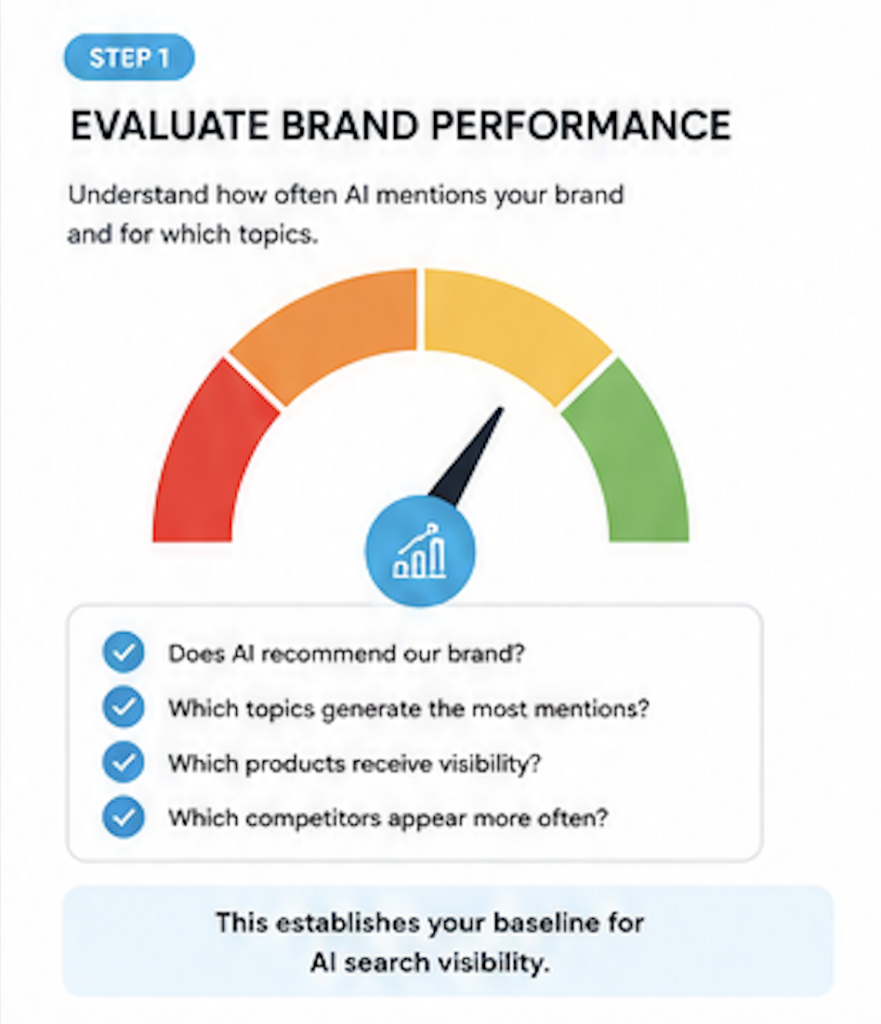
Step 1: Evaluate Brand Performance
The first step is understanding how often AI mentions your company across AI search engines. This establishes a baseline and helps answer questions like:
- Does AI recommend our brand?
- Which products or services receive visibility?
- Which competitors appear more frequently?
- Which topics drive the most mentions?
This isn’t just about counting mentions — it’s about understanding where your visibility exists and where gaps remain. Brand performance data surfaces high-performing topics, underrepresented service lines, missing product associations, and emerging market opportunities. It creates the foundation for every recommendation that follows.
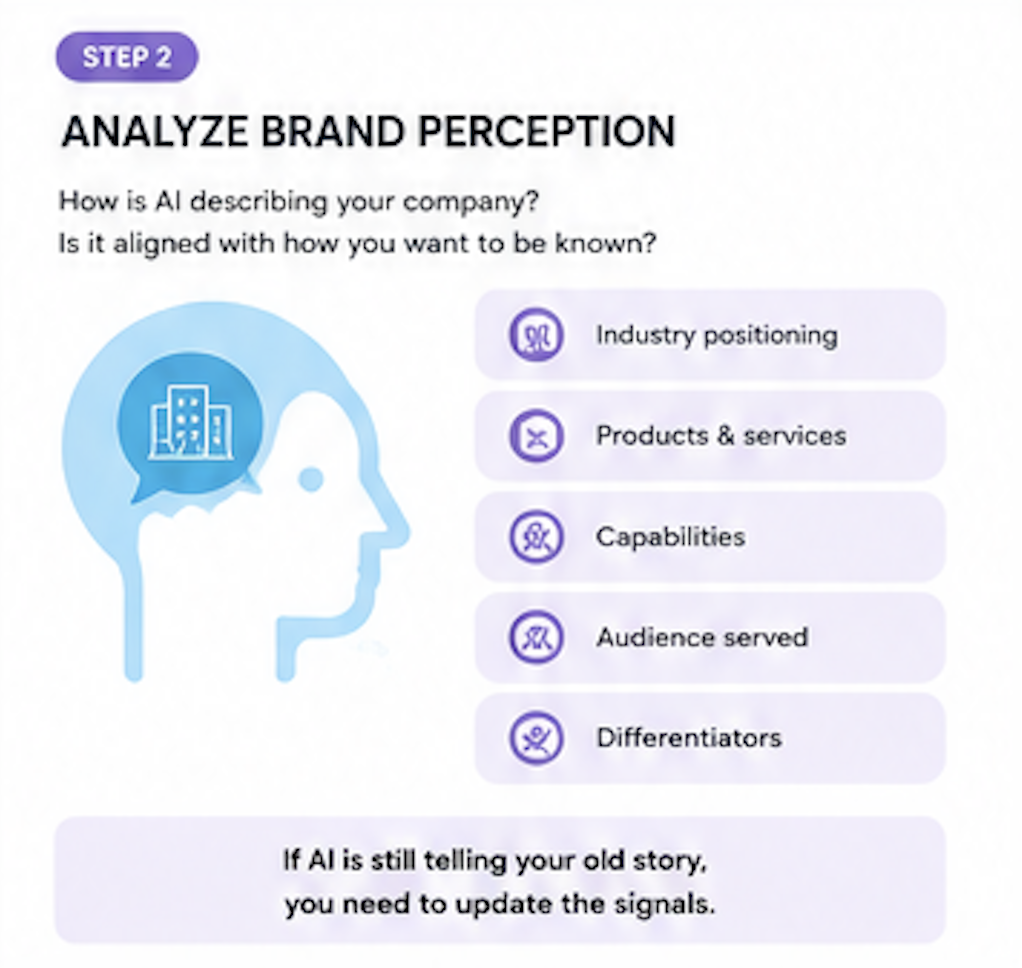
Step 2: Analyze Brand Perception
Being mentioned by AI is only part of the story. The more important question is: how is your company being described?
Brand perception evaluates the language AI consistently uses when discussing your organization. It may describe you as an enterprise software platform, an AI-driven solution, a procurement platform, or a warehouse automation provider. Sometimes those descriptions align with your current marketing strategy. Often, they don’t.
Organizations frequently discover that AI still associates them with legacy products, outdated messaging, previous acquisitions, or former target markets. This insight is especially valuable for companies undergoing significant change. If you’ve recently launched a new product, entered a new industry, or repositioned your business, AI may still be telling yesterday’s story — and understanding that gap is the first step to closing it.
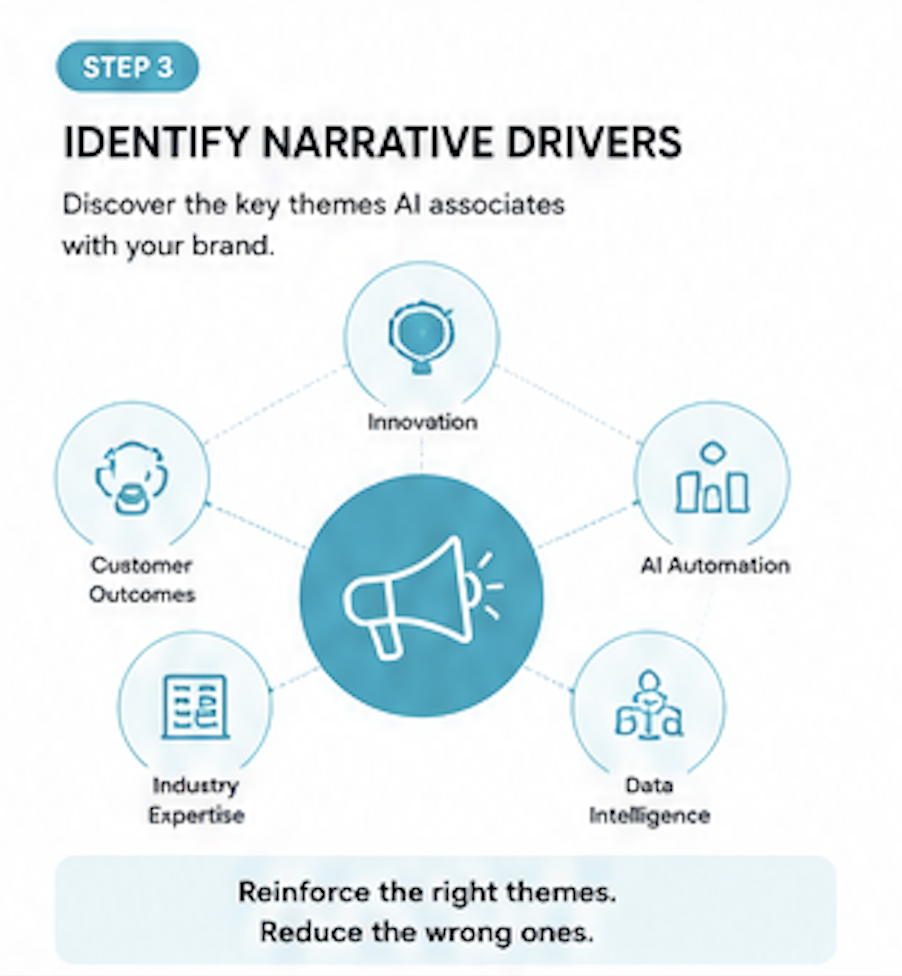
Step 3: Identify Narrative Drivers
Narrative drivers are the recurring themes AI associates with your brand. Think of them as the story AI has learned to tell about your company.
Examples might include: innovation, AI automation, supply chain optimization, enterprise security, digital transformation, or procurement intelligence. When those themes align with your business strategy, they’re powerful assets. When they don’t, they reveal opportunities to strengthen your content marketing, thought leadership, and product messaging.
This analysis answers questions like:
- Which topics define our expertise in AI-generated answers?
- Which industries does AI associate with our brand?
- Which strategic initiatives receive little or no visibility?
Rather than guessing how AI perceives your company, narrative analysis provides measurable insight into your evolving brand story.
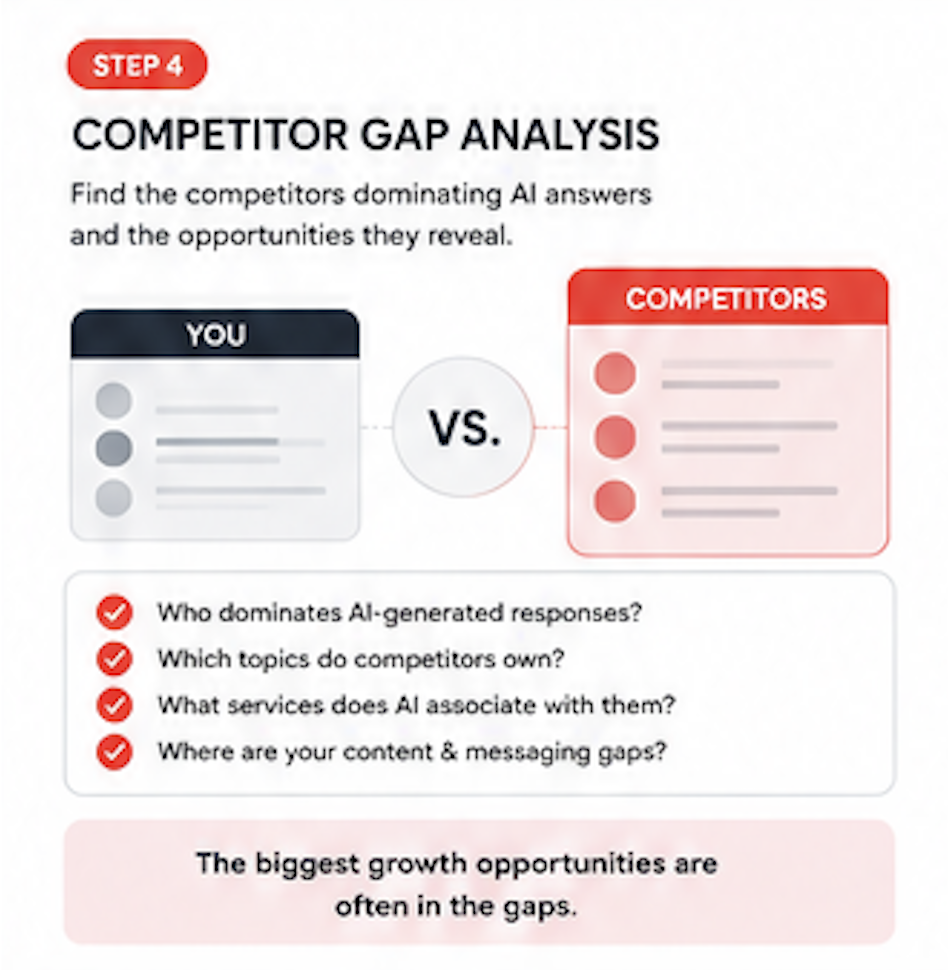
 Step 4: Competitor Gap Analysis
This is where the assessment becomes a competitive intelligence exercise.
One of the biggest surprises for clients isn’t how often they’re mentioned — it’s who gets mentioned instead. AI search engines frequently recommend competitors based on broader topical authority, stronger entity relationships, deeper content ecosystems, or more consistent brand signals.
Competitor gap analysis uncovers:
- Which competitors dominate AI-generated responses in your category
- Topics and industries competitors consistently own
- Missing content opportunities and messaging gaps
- Areas where competitors have stronger authority
Here’s an important distinction: the highest-performing competitor in AI search isn’t always the company ranking first in Google. It’s often the company AI understands best. That difference creates valuable strategic insight — instead of chasing rankings alone, marketing teams can make informed decisions about where to invest in content, messaging, digital PR, and thought leadership.
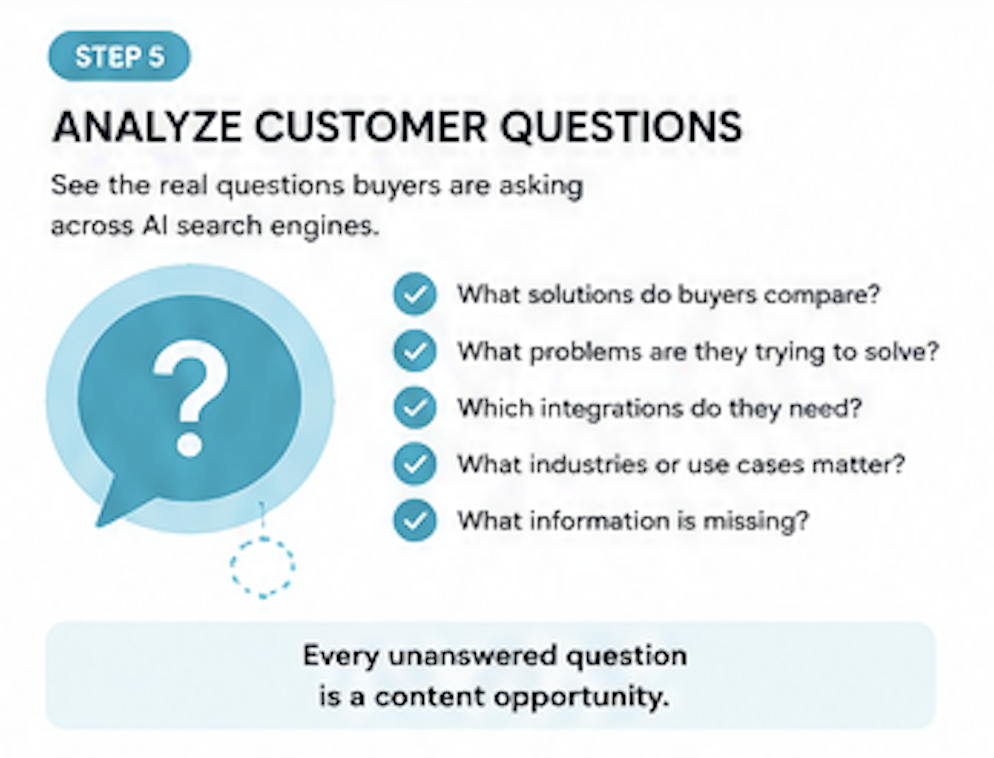
Step 5: Analyze Customer Questions Across AI Search
One of the most underrated outputs of an AI visibility assessment is the customer question data.
Unlike traditional keyword research, AI search reveals the full context behind buyer intent. Instead of individual keywords, you see the actual conversations AI platforms are having with prospective customers before they ever visit your website.
Questions often include:
- Which vendors offer AI-powered procurement software?
- What are the best alternatives to Company X?
- Which platforms integrate with SAP?
- Which companies specialize in healthcare?
This data provides a direct roadmap for content strategy. Every unanswered question is an opportunity to strengthen AI visibility while giving buyers the information they’re already searching for. The insights can inform editorial calendars, product marketing, solution pages, sales enablement, FAQ content, and thought leadership — all tied to real demand rather than assumptions.
AI Search Is a Brand Research Tool
One of the biggest misconceptions about AI search optimization is that it’s simply another SEO tactic. I see it differently.
AI search has become one of the most valuable market research tools available to marketing teams. Instead of asking “How do we rank higher?” marketing leaders can ask:
- Does AI understand our current positioning?
- Are we known for the products we want to sell?
- Are competitors owning conversations we should lead?
- Has AI recognized our recent product launch?
- Which customer questions remain unanswered?
These insights extend far beyond search. They influence brand strategy, product marketing, demand generation, public relations, and executive messaging. In many ways, AI search has become a reflection of your digital reputation. The better AI understands your company, the more likely it is to recommend your brand when buyers are evaluating solutions.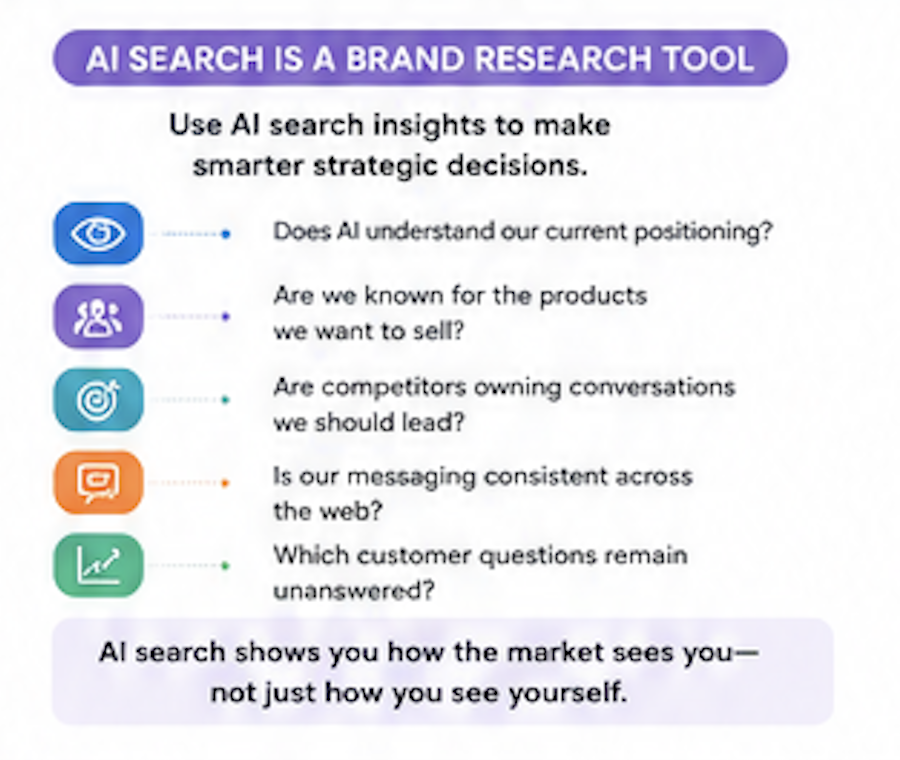
A Real-World Scenario: Repositioning After an Acquisition
Imagine a B2B SaaS company that acquires an AI startup to expand its platform. Before the acquisition, the company was known for spend analytics and reporting. After integration, it now offers AI agents that automate workflows, surface insights, and accelerate decision-making.
Internally, the transformation is clear. The marketing team has updated product pages, published a press release, and trained the sales team on the new capabilities.
But an AI brand visibility assessment tells a different story.
Across ChatGPT, Google AI Overview, Gemini, and Perplexity, the company is still described using its legacy positioning. AI recognizes the brand for reporting and analytics but rarely associates it with AI agents or intelligent workflow automation. Meanwhile, competitors that have spent years publishing educational content around AI agents dominate AI-generated responses.
The challenge isn’t that the company lacks innovation. It’s that AI hasn’t learned the new narrative yet.
That insight changes the marketing strategy. Rather than producing more generic blog posts, the team focuses on the signals that help AI connect the brand with its expanded capabilities:
- Dedicated solution pages for AI agents
- Educational content around new use cases
- Expanded comparison and alternative pages
- Refreshed executive thought leadership
- Stronger internal linking and schema
- Digital PR reinforcing the new positioning
- Topical authority built around AI automation
Over time, these efforts help AI recognize the company’s current identity — improving both brand awareness and visibility across AI search.
Technical SEO Still Powers AI Search Visibility
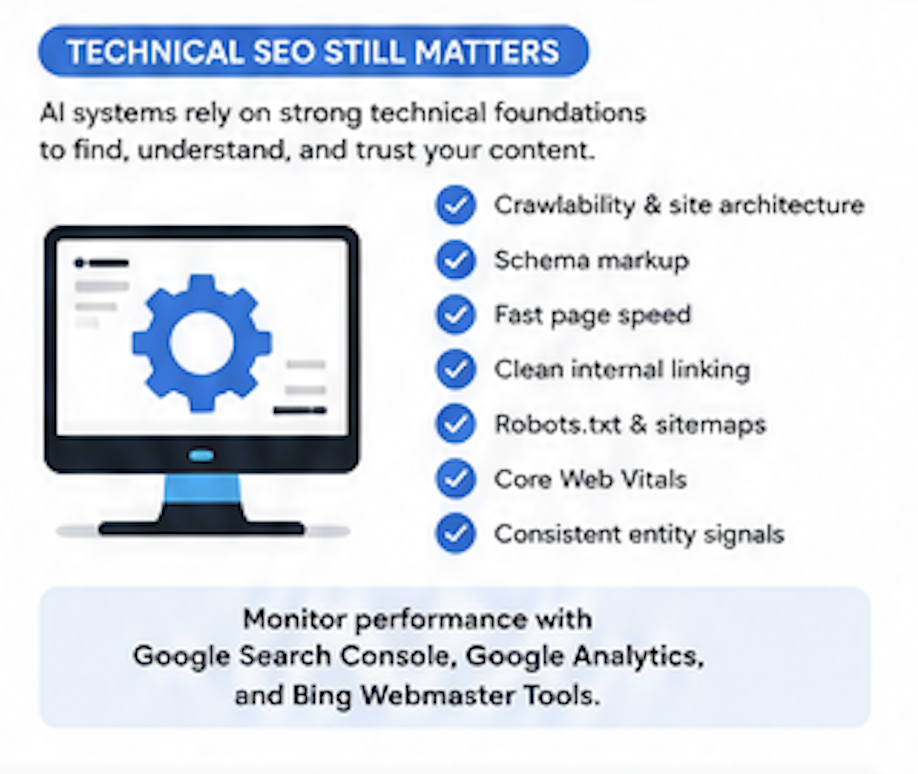
Despite all the attention surrounding generative AI, technical SEO remains the foundation of AI search optimization. AI systems rely on well-structured, trustworthy content to understand your business.
A strong technical foundation includes:
- Logical site architecture and clean internal linking
- Schema markup and accurate metadata
- Crawlable pages and fast page speed
- Consistent entity signals and updated XML sitemaps
Tools like Google Search Console, Google Analytics, and Bing Webmaster Tools continue to play an important role in monitoring indexing, crawling, technical health, and search performance. Poor technical SEO won’t just hurt rankings — it can limit AI’s ability to fully understand and trust your content.
How to Improve AI Brand Visibility
Improving AI visibility isn’t about chasing a single ranking factor. It’s about creating a consistent, trustworthy digital presence that helps AI accurately understand your brand.
Strengthen your content ecosystem. Build comprehensive topic clusters around your products, services, and areas of expertise rather than publishing isolated articles. Educational resources, buying guides, solution pages, industry insights, customer success stories, and original research all deepen your topical authority.
Align your messaging. AI pulls information from many sources. If your website, LinkedIn, and press releases tell different stories, AI may struggle to determine your true positioning. Review messaging across all owned channels — product pages, executive bios, sales collateral, and social — and make sure they reinforce the same narrative.
Build stronger brand signals. AI doesn’t rely on your website alone. It also considers your broader digital footprint. Invest in digital PR, industry publications, podcast appearances, executive thought leadership, speaking engagements, and original research. Every credible mention reinforces your expertise.
Continue investing in technical SEO. AI search optimization builds on SEO, not around it. Keep improving internal linking, schema markup, crawlability, structured content, and page experience.
When to Conduct an AI Brand Visibility Assessment
An AI visibility assessment is valuable at any stage, but it becomes especially important during periods of change. Consider conducting one if your company has recently:
- Acquired another business
- Launched a new product or service
- Introduced AI capabilities
- Entered a new market or rebranded
- Shifted target audiences
- Expanded internationally
- Updated its messaging
These milestones often change how you want the market to perceive your brand. An assessment helps determine whether AI has recognized that change — and what it will take to close the gap.
Frequently Asked Questions
What is AI brand visibility? AI brand visibility measures how frequently and accurately your company appears in AI-generated responses across platforms like ChatGPT, Google AI Overview, Google AI Mode, Gemini, and Perplexity.
What is AI search optimization? AI search optimization is the process of improving how AI systems understand, reference, and recommend your brand by strengthening content, technical SEO, entity relationships, and brand authority.
Does Google AI Overview replace traditional SEO? No. Google AI Overview builds on traditional search signals. Strong technical SEO, helpful content, and authoritative websites remain essential.
How do AI search engines decide which brands to recommend? AI systems evaluate topical authority, trusted sources, structured content, brand mentions, technical quality, and the consistency of your digital presence.
Can AI visibility help after a merger or acquisition? Yes. An AI visibility assessment identifies whether AI recognizes your expanded products, services, or positioning — and gives marketing teams a roadmap for reinforcing the new narrative.
What is Semrush’s AI Visibility Toolkit? It’s a reporting suite within Semrush that helps marketers evaluate AI brand performance, perception, narrative drivers, competitor visibility, and customer questions across multiple AI search platforms. I use it as the data foundation for every AI brand visibility assessment I conduct for clients — it makes the abstract measurable, and gives us a starting point for building a smarter content and messaging strategy.
Is AI search replacing Google Search? No. AI-powered search is expanding how people discover information, but traditional search remains an important part of the customer journey.
Final Thoughts
Search has evolved beyond rankings.
Today, marketers need to understand not only whether their content appears in search results, but whether AI systems recognize their expertise, accurately represent their brand, and recommend them during critical buying moments.
That’s why I view AI visibility as more than another reporting metric — it’s a strategic lens into how your company is perceived across one of the fastest-growing channels for research and discovery.
By evaluating brand performance, perception, narrative drivers, competitor gaps, and customer questions, organizations gain insights that shape content strategy, product marketing, messaging, public relations, and thought leadership. The companies that win in AI search won’t simply publish more content. They’ll build a digital ecosystem that helps AI confidently answer one question:
“Is this the brand I should recommend?”
Interested in understanding how your brand appears in AI search? Contact BOHO SEO to learn more about our AI Brand Visibility Assessment.
